
My Girl with a Pearl (2020)
cross-stitch on white poplar leaf


My Girl with a Pearl (2020)
cross-stitch on white poplar leaf

Selfie 2.0 (2020)
cross stitch
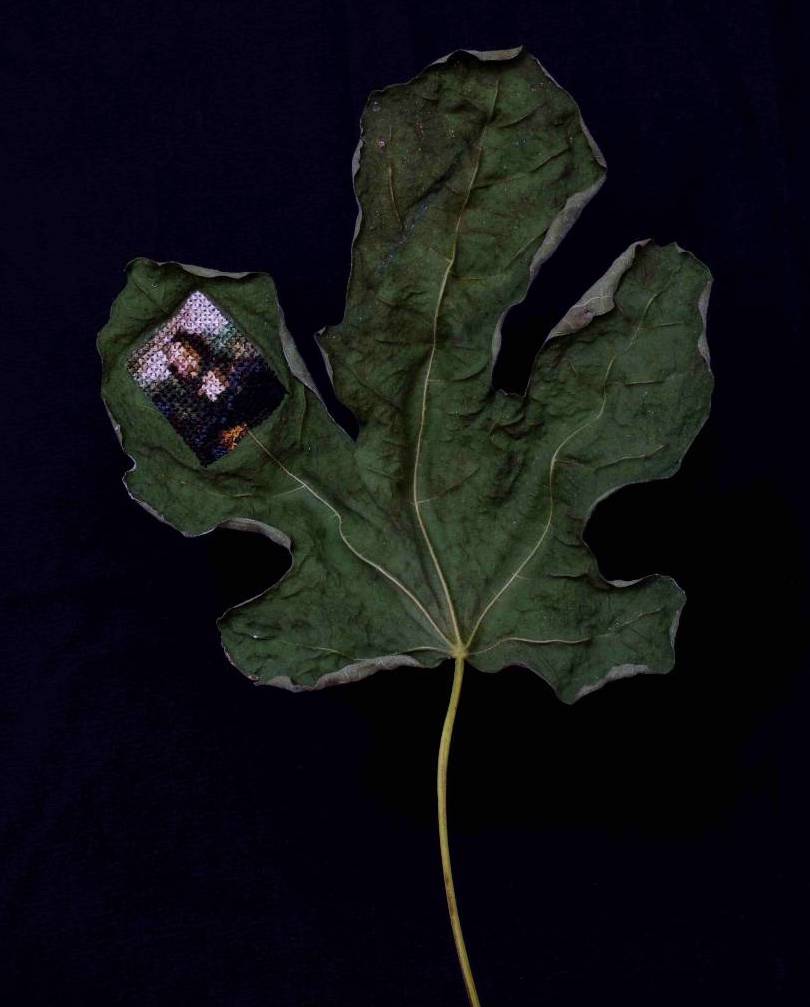
Mona Lisa Series, When Time Goes By (2020)
cross-stitch on fig leaf

Girl with Sailor Dress (2020)
Thread on linen

No title (2024)
silk cross-stitch on stamps
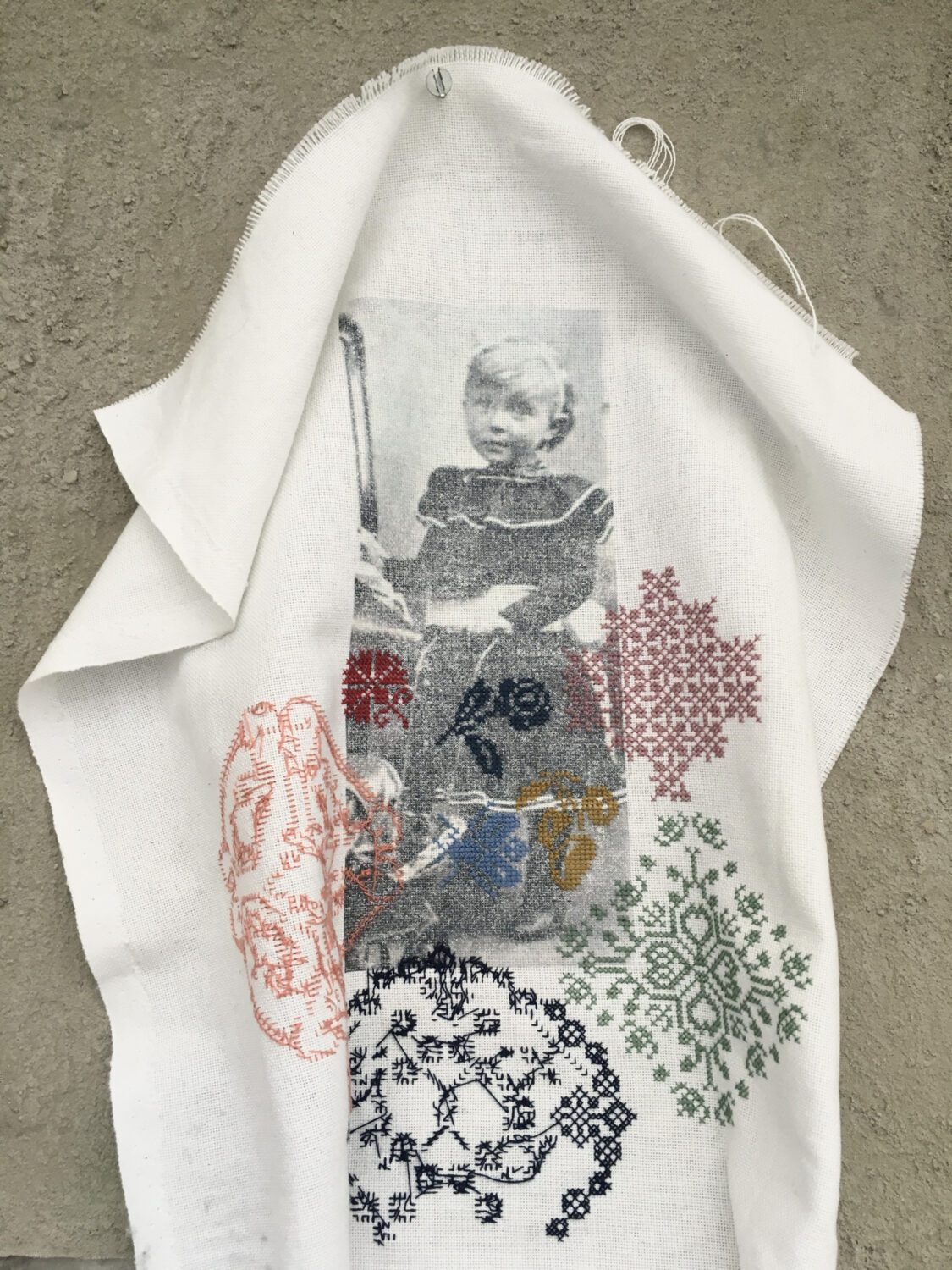
Oma (2021)
embroidery on linen
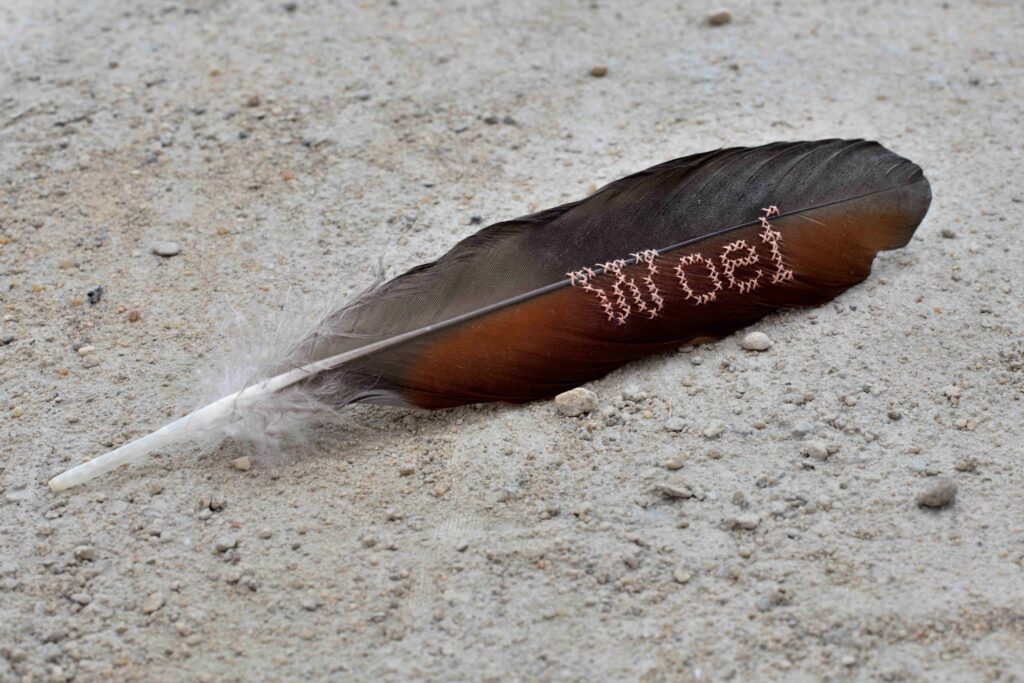
W O E F (2020)
cross-stitch on feather

Lead book (2025)
cross-stitch on metal
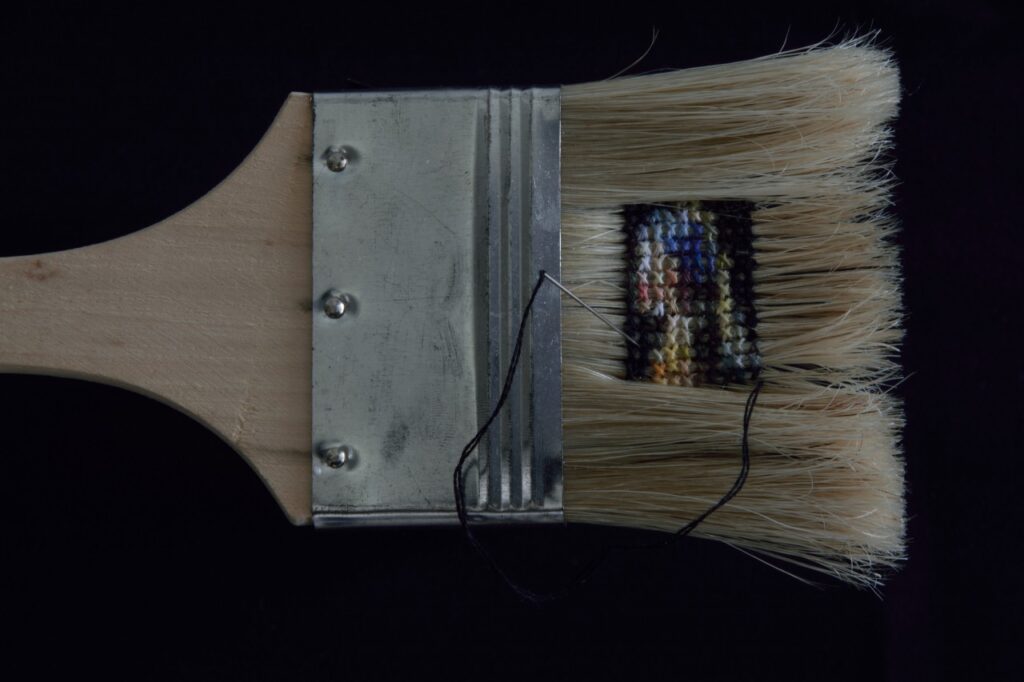
My Girl with a Pearl (2019)
cross stitch on brush
Dutch textile artist Renee Toonen lives in Amsterdam and uses an innovative range of canvases for her meticulous hand embroidery. The background often has as much impact as the stitches themselves making the viewer pause for reflection and look at every day objects in a different light.
What is your background in textile art?
For several years I had a business designing bespoke shirts. They were all unique eye-catching pieces and most of the clients were male musicians or worked in theatre. It was successful until my mobility decreased and in 2017 I turned my attention to thread. Through embroidery I found a new way to explore my ideas around colour, composition and technique.
How do you describe your work?
My work is developed and varied. The first part is very traditional. The series Mending Holes in Family History grew from something small — an old family photo album — into something much larger. My mother and aunt gave words to the images; I gave them thread. I used a centuries-old technique: darning, as girls were taught in orphanages from 1799 onward. I am fascinated by the idea that repair is more than restoration — it is acknowledgment, preservation, and giving meaning.
In my creative exploration, I work with materials not used in embroidery art: lead, leaves, paper cuttings, oil paint, photographs, brushes, and feathers — materials that spark my curiosity and become the canvas for my stitches. The result is an answer to the question: What if?
This question forms the constant thread in my work — the ongoing challenge. Through using unconventional materials, I create new images that do not immediately resemble embroidery. Yet the stitches — often cross stitches — define the essence of my work. I like to surprise the viewer by placing seemingly ordinary objects in a disorienting, unfamiliar context.
What is it about using textiles / fibre that appeals to you?
For many people from my generation (1966) it is the fact that they grew up with mothers and grandmothers who sewed their own clothes, and knitted socks and sweaters. In my case they also loved to embroider. My grandma taught me how to knit before I could even read. The miracle that a ball of wool can turn into a sweater was the start of my fascination for textiles.
Can you talk us through designing a piece of work please?
The process of making is always a search because all the different materials need a unique approach. But one thing is similar: it always starts with a lot of thinking. Answering the question ‘how can it be done?’ is the most important part of the making process. I write down all of the ideas that cross my mind in my little black book – that is overloaded with ideas.
When I have finished the work I complete the specific idea in my book with some of the material I used. The reason I write it down is practical: There is no fear to forget and it gives me space in my creative thinking.
Where do you work?
I work from home, mostly just at the kitchen table.
I know it’s a hard question but how long does a piece generally take to make?
Most small work takes a week to make. I have to make the work with leaves in one day because I don’t prepare them and it’s only possible to embroider on them when they are fresh from the tree.
What has been your proudest career moments so far?
In 2018 I won the TxP Magazine art prize (TxP is the Dutch magazine for textile art.) It gave me the opportunity to be part of a beautiful exhibition in the Museum Kantfabriek in Horst – an old lace factory that is now one of two textile museums in the Netherlands. A year later my work was, by invitation, seen by almost 6,500 visitors at the Textiel Plus Festival.
In 2021, I held first solo exhibition at Cloud Gallery in Amsterdam. Shortly thereafter my work was shown during Rome Art Week, where it was praised in the Italian newspaper La Repubblica in an article titled “The Magic of the Cross Stitch.”
What advice can you give aspiring textile artists?
Enjoy the period where you find your own style. Look further than only what other textile artists are making. Let your inspiration be other kinds of art. With embroidery, stress and embroidery don’t go together. That’s why it is such a wonderful technique for me.