
Red, White, and Blue 1 (2018)
92h x 106w inches
rust dyed vintage linens, hand painted and block printed recycled fabric, composted toile, deconstructed clothing, hand stitched and embroidered


La Cadie Diaspora
96”h x 86”w
composted repurposed textiles, discarded garments, stencil ink, machine and hand stitching and embroidery
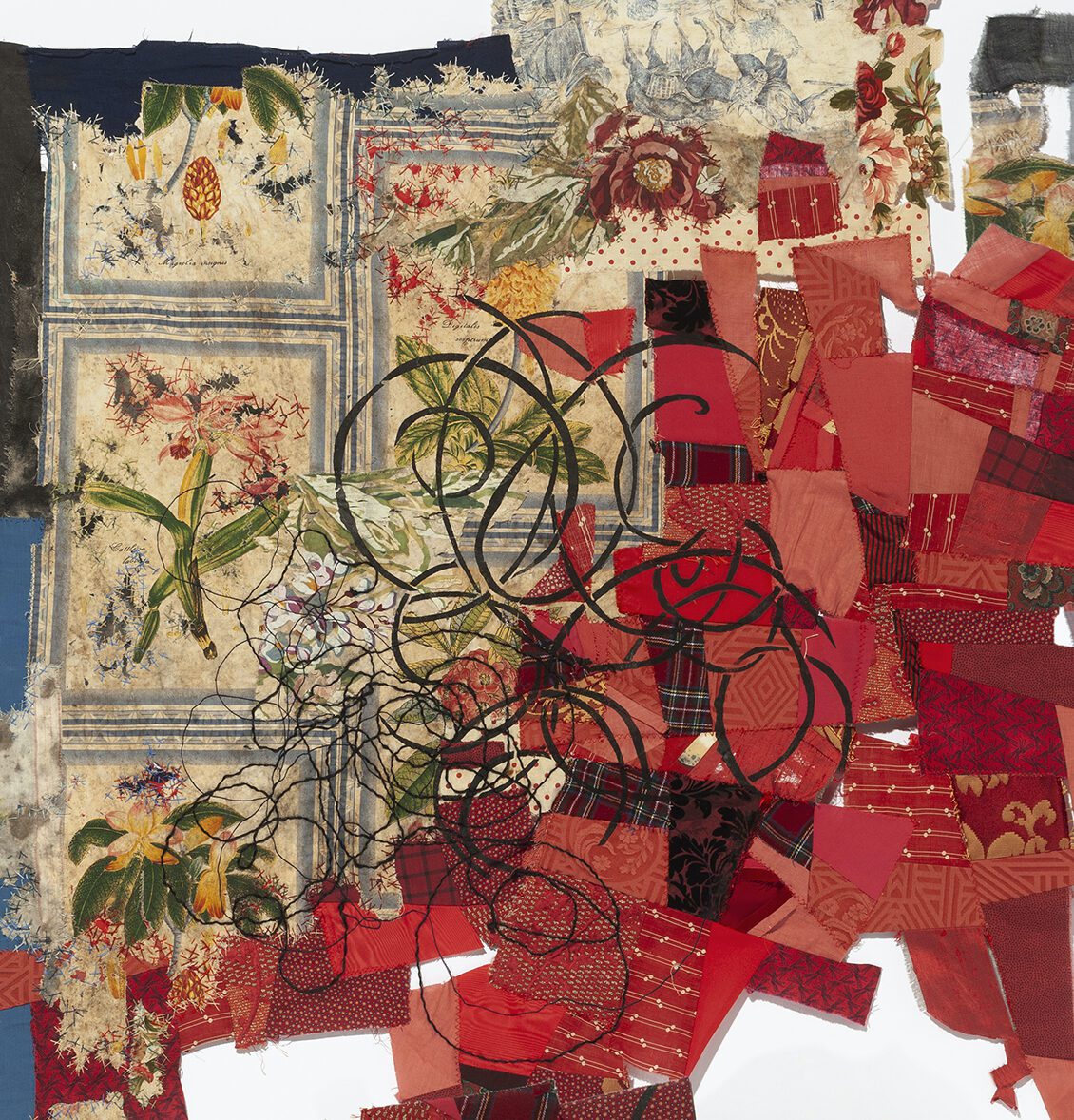
La Cadie Diaspora – Detail
96”h x 86”w
composted repurposed textiles, discarded garments, stencil ink, machine and hand stitching and embroidery

Archive of Specimens
size varies depending on installation approx. 84”h x 48”w
painted repurposed cloth, paper, pencil, embroidery thread, insect pins

Archive of Specimens – Detail
size varies depending on installation approx. 84”h x 48”w
painted repurposed cloth, paper, pencil, embroidery thread, insect pins
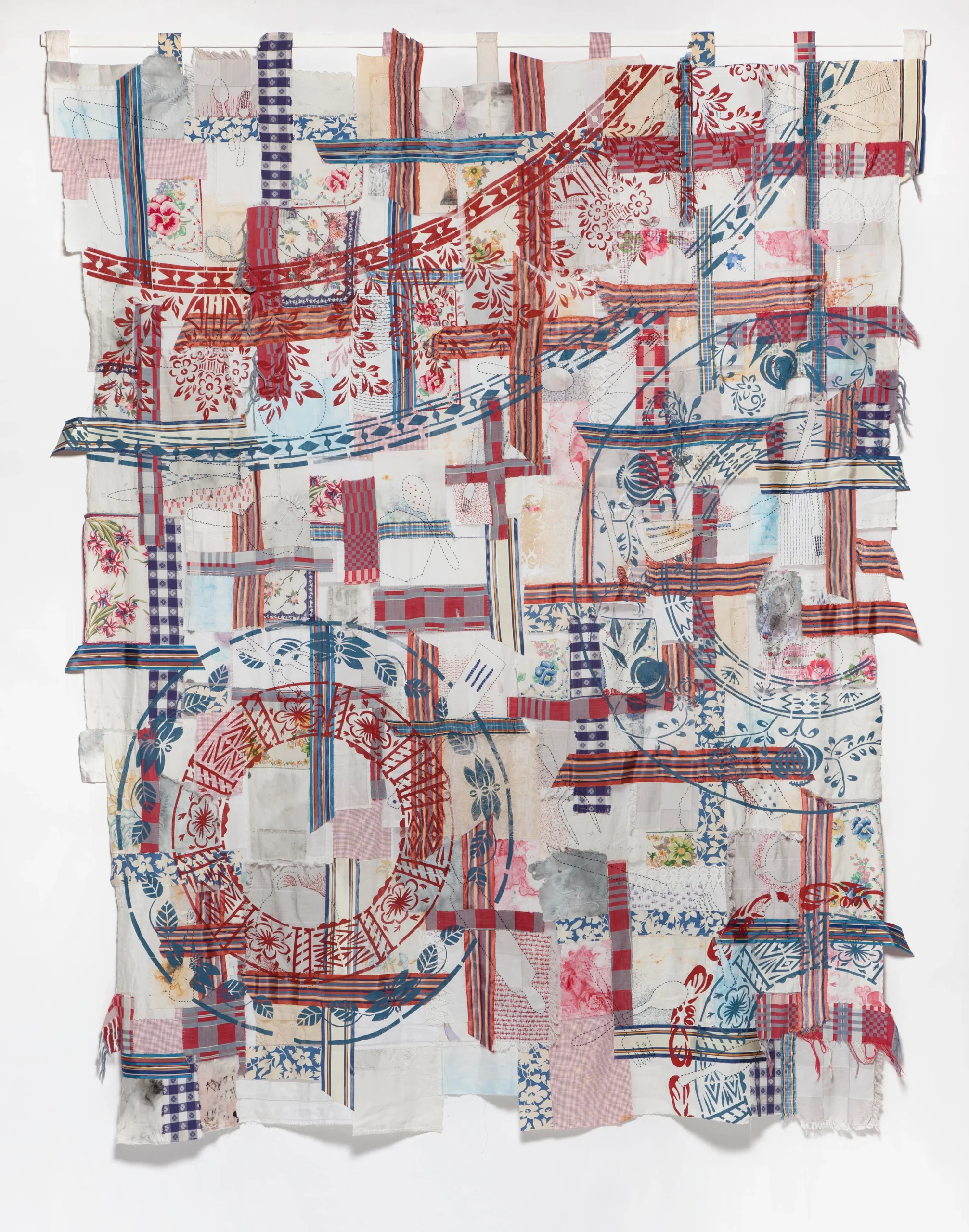
Fond Memories of Good Company
102”h x 78”w
repurposed textiles from the artist’s dining room and kitchen, embroidery threads, stencil inks, hand stitching

Mother, Daughter, Mother They, Daughter (2022)
24h x 16w x 8d
vintage hand made child’s dress, paper bag snippets, hair, thread
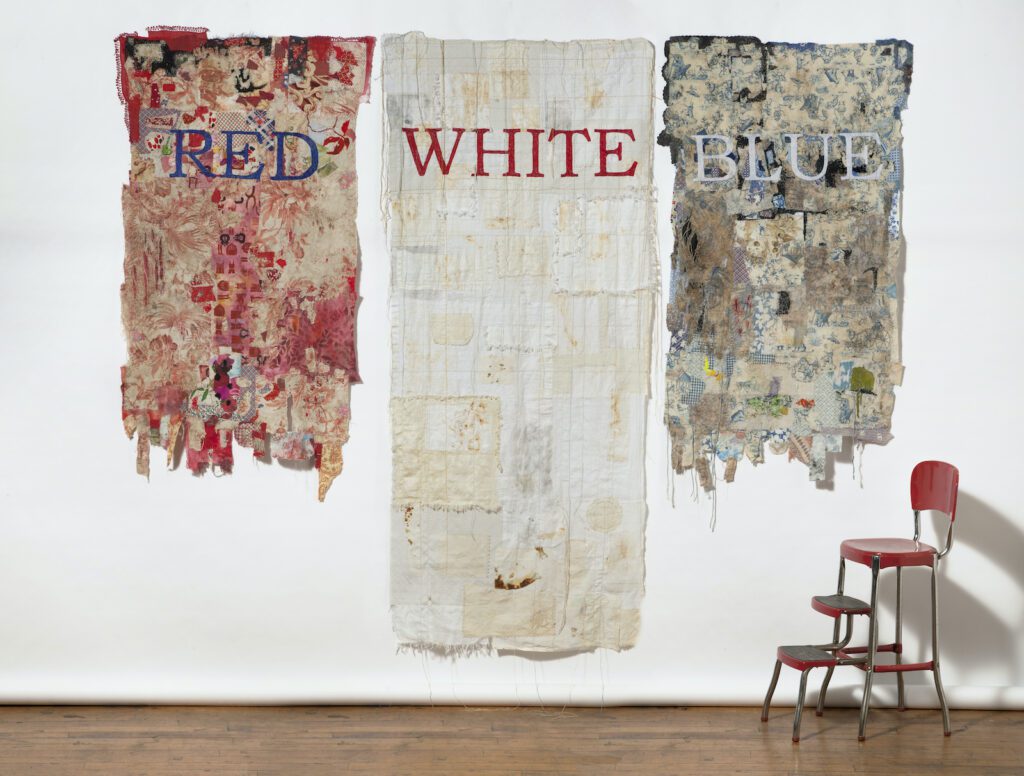
Red, White, and Blue 1 (2018)
92h x 106w inches
rust dyed vintage linens, hand painted and block printed recycled fabric, composted toile, deconstructed clothing, hand stitched and embroidered
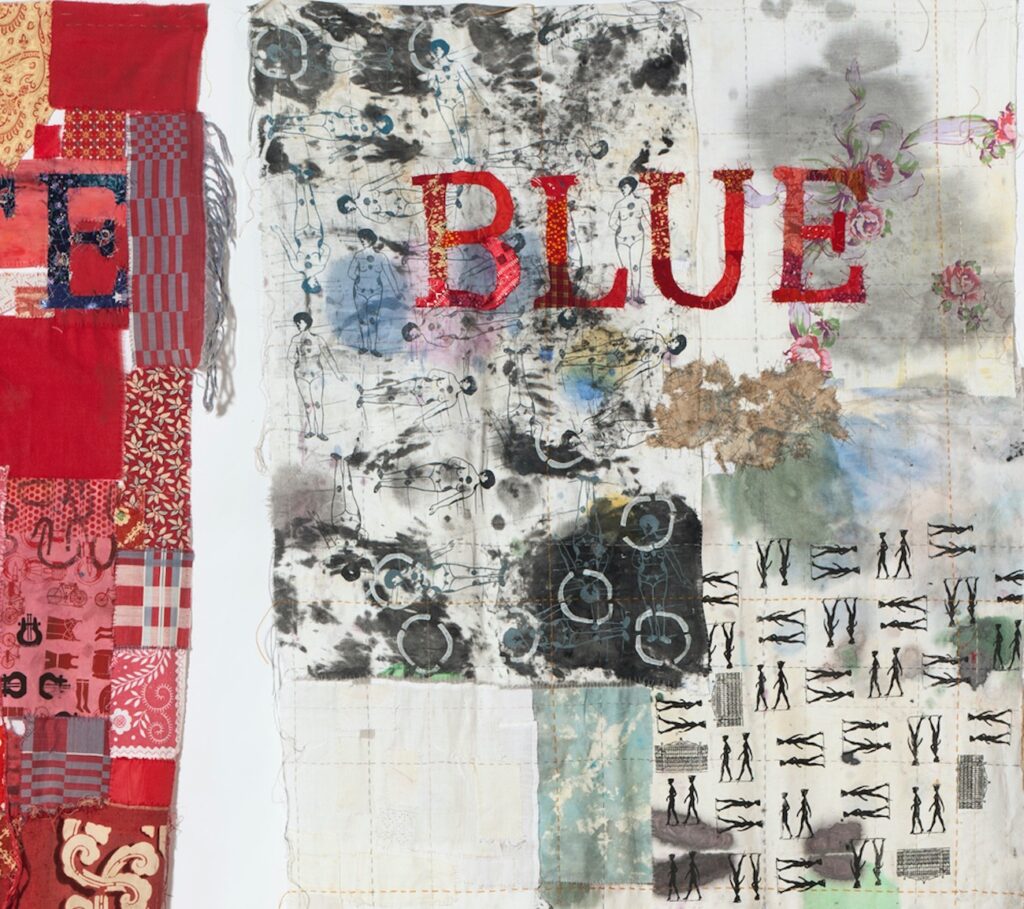
Red, White, and Blue 2 (detail) (2019)
102h x 116w x 36d inches
deconstructed repurposed clothing and linens, painting, block printing, and thermo-faxed images, hand stitched

Red, White, and Blue 2 (2019)
102h x 116w x 36d inches
deconstructed repurposed clothing and linens, painting, block printing, and thermo-faxed images, hand stitched
American textile artist Merill Comeau’s installations, wall hangings, paintings and garments have been featured in over 90 exhibitions. Her work investigates ‘current socio-political issues,’ and her ‘choices of materials and processes are informed by trauma and feminism and reflect my concern about the environment and unequal use of resources.’
Firstly where did you grow up and where do you live now?
I am a born and bred New Englander. I live in Concord Massachusetts – a town of historic significance to the American Revolutionary War of Independence and the birthplace of Transcendentalism. The town is rich in history and supports a thriving contemporary scene of writers, artists, and family farms. People say New Englanders are unfriendly, but I think we are just shy and reserved.
What is your background in textiles?
My undergraduate degree is in social theory and political economy; a major that involved forays into women’s studies, philosophy, sociology, and psychology. I am interested in the ways we organize as societies and families and how material culture communicates our values. I studied architecture in my thirties and worked as an architectural designer for 25 years. I’ve studied art and textile history and feminist theory. In my strong palette, all-over imagery, and hanging of loose fabric on the wall, I owe a debt to the Pattern and Decoration Movement. In my use of recycled clothing and sewing construction, I pay homage to precedents such as women patching together salvaged bits of cloth to make quilts. My background supports the conceptual underpinnings of my work and my facility with the formal elements of design. I love being an artist — making art engages all parts of me: mental, physical, and psychological.
What is it about textiles as an art form that appeals to you?
I choose to work in textiles because they are essential to everyday life: we are swaddled at birth, sleep in linens, bundle up to protect ourselves from weather, don fashion to assert our identity, use ritual cloth to evoke meaning, and reverently dress our deceased for burial. I collect textiles as a form of ‘souvenir’. I acquired my first piece at age 15, a delicate and damaged Chinese embroidery that I painstakingly restored. Other collected textiles of meaning include a piece of a crewel embroidery from a distant relative, kimono silk from my husband’s grandmother’s trips to Japan, an antique paisley tablecloth from my mother, and rustic woven towels given to me on a trip to Transylvania. I also collect abstract patterned 50s bark cloth seeded by leftover scraps of my parents’ drapes and African prints, some of which were purchased on a trip I took with my niece to Ghana. My collection carries memories and symbolizes lives lived.
In addition to the joys of collecting, my studio practice provides me with the sensual pleasure of working with cloth. I enjoy the whole body demands of creating large work and the contrasting small motor skills and quietude of hand stitching. I like the processes associated with altering textiles: marking making (dying, stitched resist, block printing,) construction (sewing, 3-D fabric manipulation, seaming, repair) and decoration (embroidery, applique, embellishment.) I appreciate the forgiving quality of cloth, you can deconstruct, reconstruct, mend, and repair. Ninety percent of my materials are given to me by people in my community and I feel surrounded and comforted by their symbolic presence. In addition, I enjoy the artists I meet in the fiber world – they are welcoming and generous.
How do you describe your work?
I investigate autobiography and current socio-political issues while creating installations, wall hangings, paintings, and garments. I am inspired by traditions of craft, underrecognized domestic labor, and the history of ‘women’s work’. My choices of materials and processes are informed by trauma and feminism and reflect my concern about the environment and unequal use of resources.
I employ worn fabrics of the domestic sphere and expressive stitch to convey contemporary narratives of mending and endurance. My multifaceted approach uses text to convey or imply meaning, abstraction to mirror and interrogate the cacophony and complications of everyday experiences, and imagery from nature as a symbol of our life cycle. As I stitch hundreds of snippets together, each part becomes integral to the whole, akin to the sum of the many moments that make up a lifetime.
How do you create a piece?
I am very planful about my time, goals, and commitments. I research, write, and sketch developing my studio objectives and conceptual underpinnings. My first source of inspiration is generally self-reflection, second is my community (family, friends, students,) and third is my awareness and understanding of issues and experiences that bind us together as human beings. At the start of every project, I have something I need to say, get off my chest, or puzzle through.
A variety of sketchbooks support my artwork development. In one I keep a myriad of images that inspire the abstract printing blocks I use creating patterned yardage. I dedicate one to observational drawing and another is filled with images of beautiful flora. Most important is my idea book in which I make rough pencil sketches and jot down notes and brainstorms.
My constantly developing stash of repurposed textiles inspires my storytelling. I consider it my ‘job’ to translate materials from their original form into my own visual language. I deconstruct with seam ripper, tear, or cut. I degrade by composting (in my garden bin of leaves, kitchen waste, and worms,) rusting, staining, dyeing, or painting. I add and embellish with thermo-faxing, block and screen printing, and drawing. I use vibrant colors for stories of rebirth and abrading techniques to express the ephemeral nature of our existence.
I may start with a preconceived image, but once I’m ‘in the zone’, my pieces take on a life of their own. I begin by laying supplies down on the floor; almost immediately nascent images appear. I intuitively rearrange and move elements into place pursuing form, line, and movement. All my choices reinforce the story I’m telling. I tentatively pin or adhere then hang the work to edit. In the final stages I sew; my variety of stitching styles further reinforce my tales.
I know this is a hard question but how long does a bigger piece take?
Estimate: If I did one at a time, the large wall textile murals would take four weeks to six months to complete. It is hard to know exactly because in my working method I usually have six to ten projects going at once. Some projects are so complex and such slow processes that they take five or more years to complete. For example, Comb Your Hair and Put on Some Lipstick, created from my deceased mother’s shirt lined with my hair, took five years. Women’s Work is Never done developed over seven years. I’m imagining my current La Cadie Diaspora series will also take years!
You’ve had work in over 90 exhibitions. What are you most proud of in your art career so far?
I am very fortunate to exhibit as often and widely as I do — yet most meaningful to me are the conversations I’ve had with viewers when we connect over shared experiences. Art is my attempt to communicate. When my work ignites a conversation in which we discover what we share I feel a circle is completed.
Do you have any advice for aspiring textile artists?
Don’t let people discourage you because of potential income limits. There are related jobs in arts administration, education, and community programming that will support you as you build your practice.
Be a person that is planful about studio time – devise strategies to keep your self-directed artmaking going. Create and/or join artist groups; surround yourself with generous people who support your efforts, remind you that you are an artist, and inspire you to keep making.
Although the processes of creating art are the most fun, being an artist requires running a small business. For instance, I spend at least two days a week on administration: writing press interviews, formulating proposals, filling out loan-agreements, ordering supplies, etc.
Everything you make will not be a masterpiece. Often, you will find that you do not like your output. Turn that discouragement into energy that propels you to make the next, better piece. Don’t fear fallow times and be grateful for fertile times.
Apply, apply, apply to opportunities. Pick yourself up after rejections and celebrate your successes. For artists, tenacity is key.
There are some people in the art world who see a hierarchy. For example, they see painting as a higher art form than textiles or they see craft as lower than fine arts. My advice specifically to textile artists is that this hierarchy of value is small-minded; don’t let it influence you.
One special opportunity for creative folks is the extensive international array of artists residencies available to you — research to see if you can find one that fits your schedule and budget, apply, and attend.