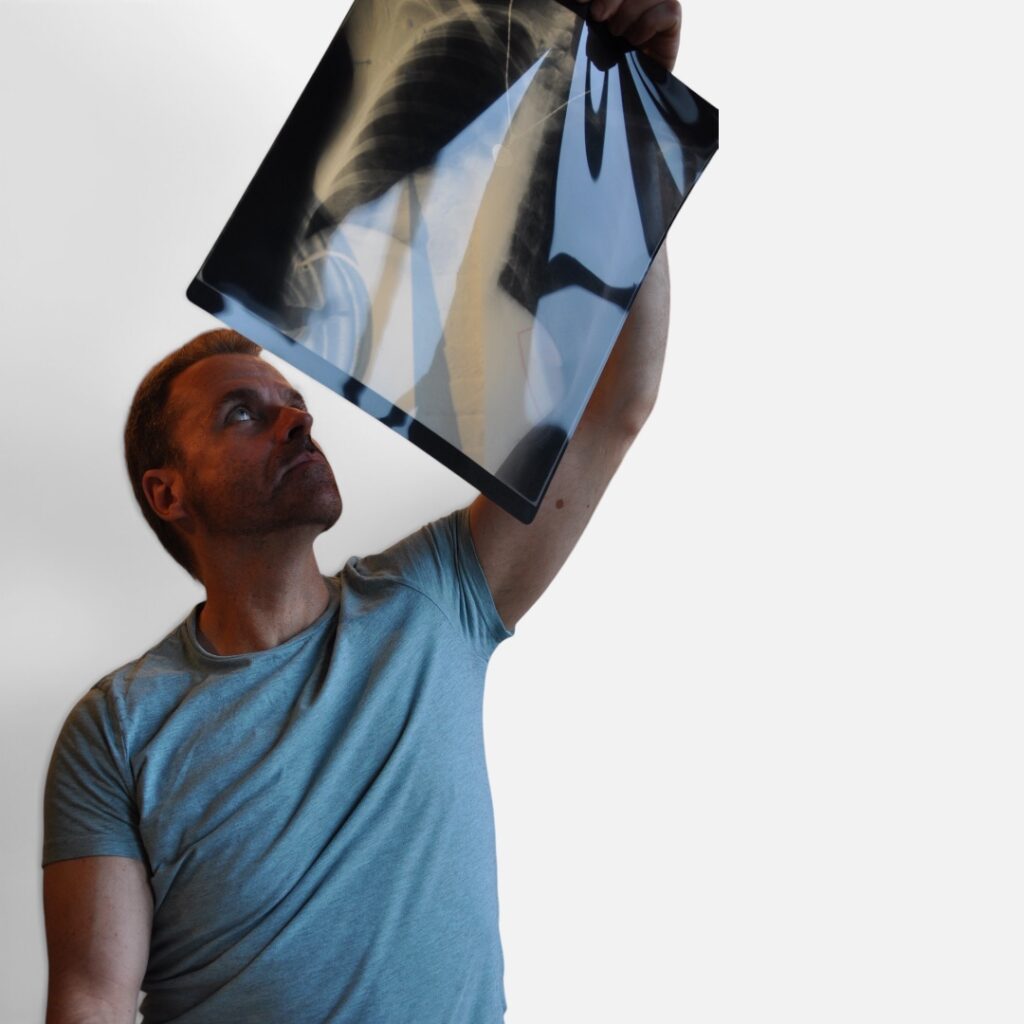
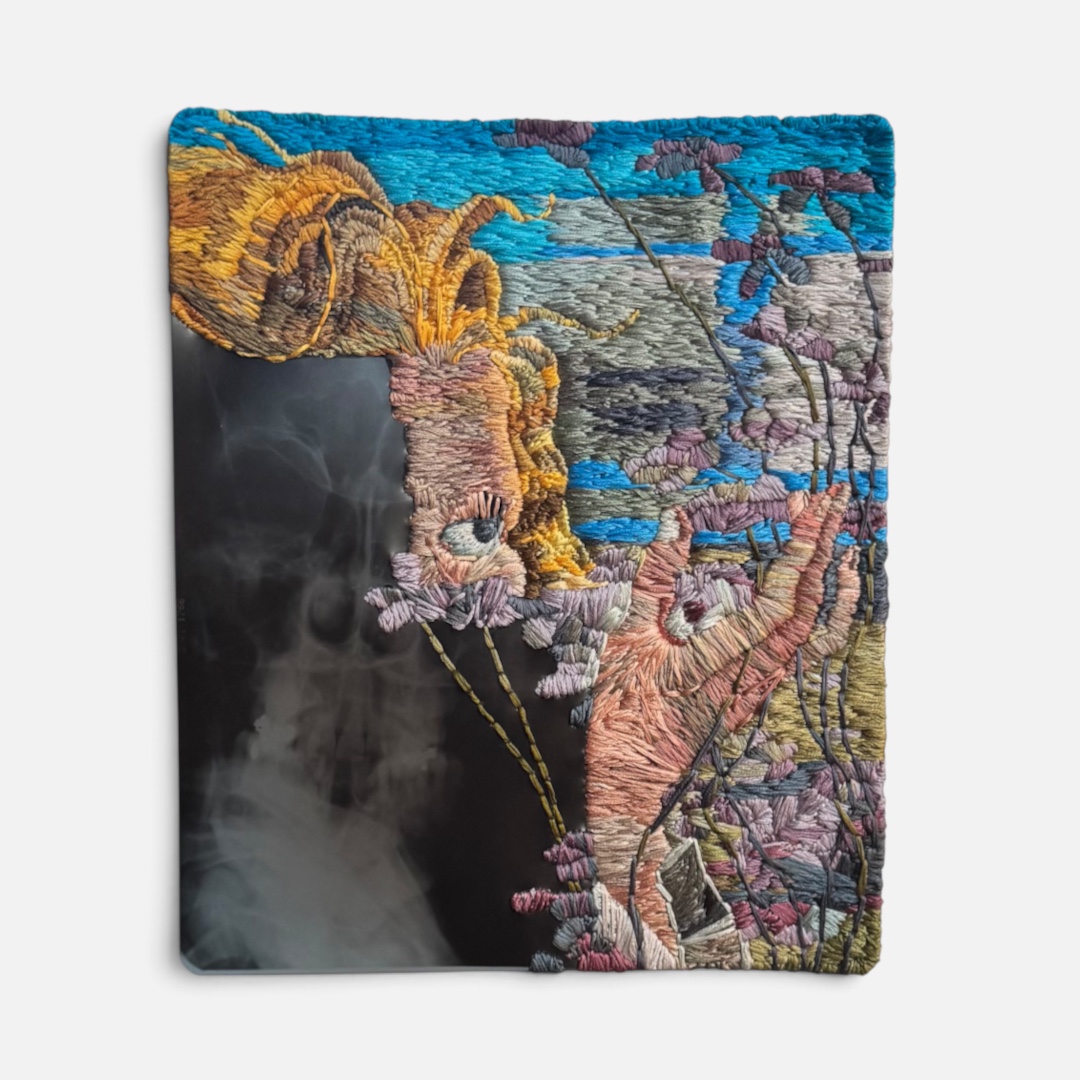
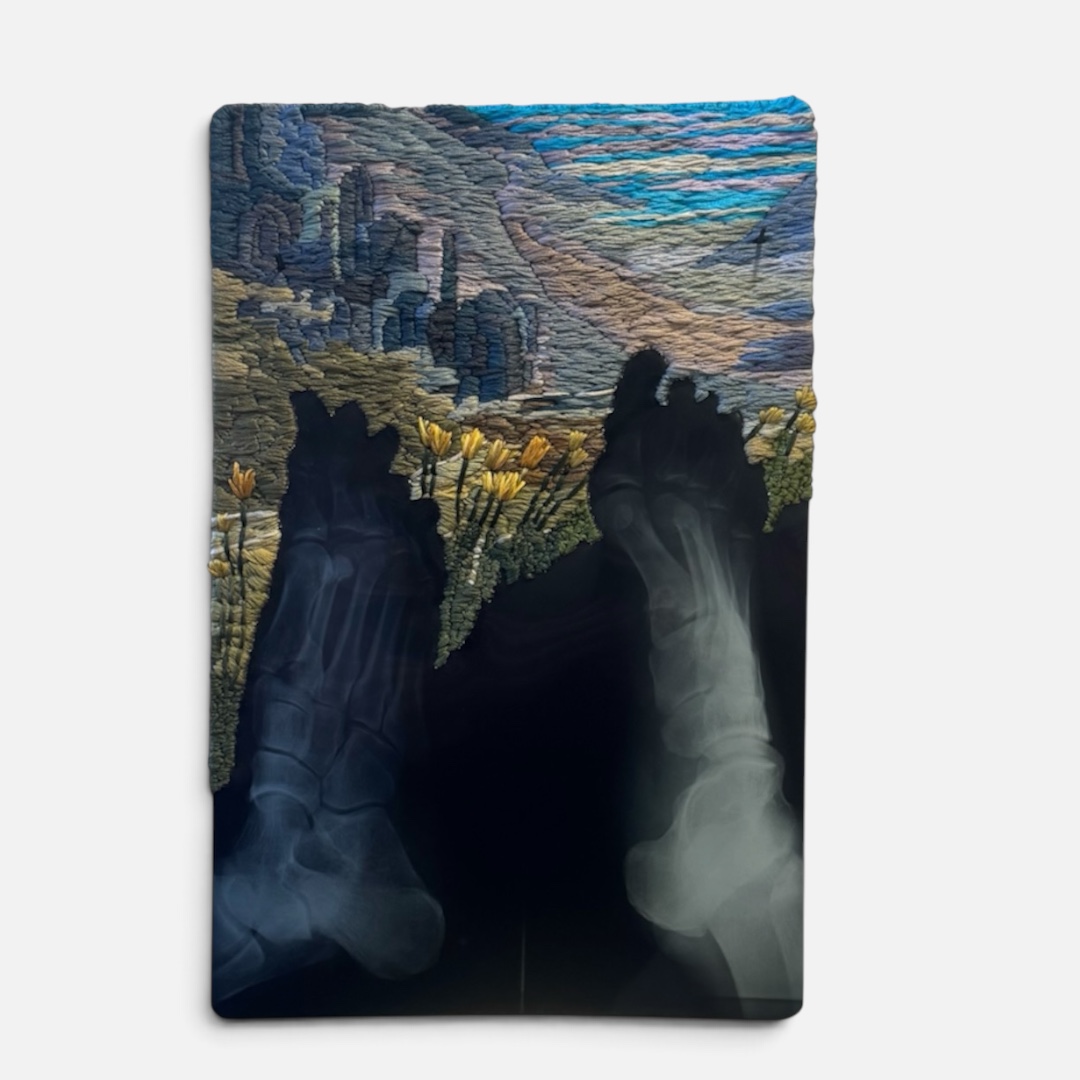
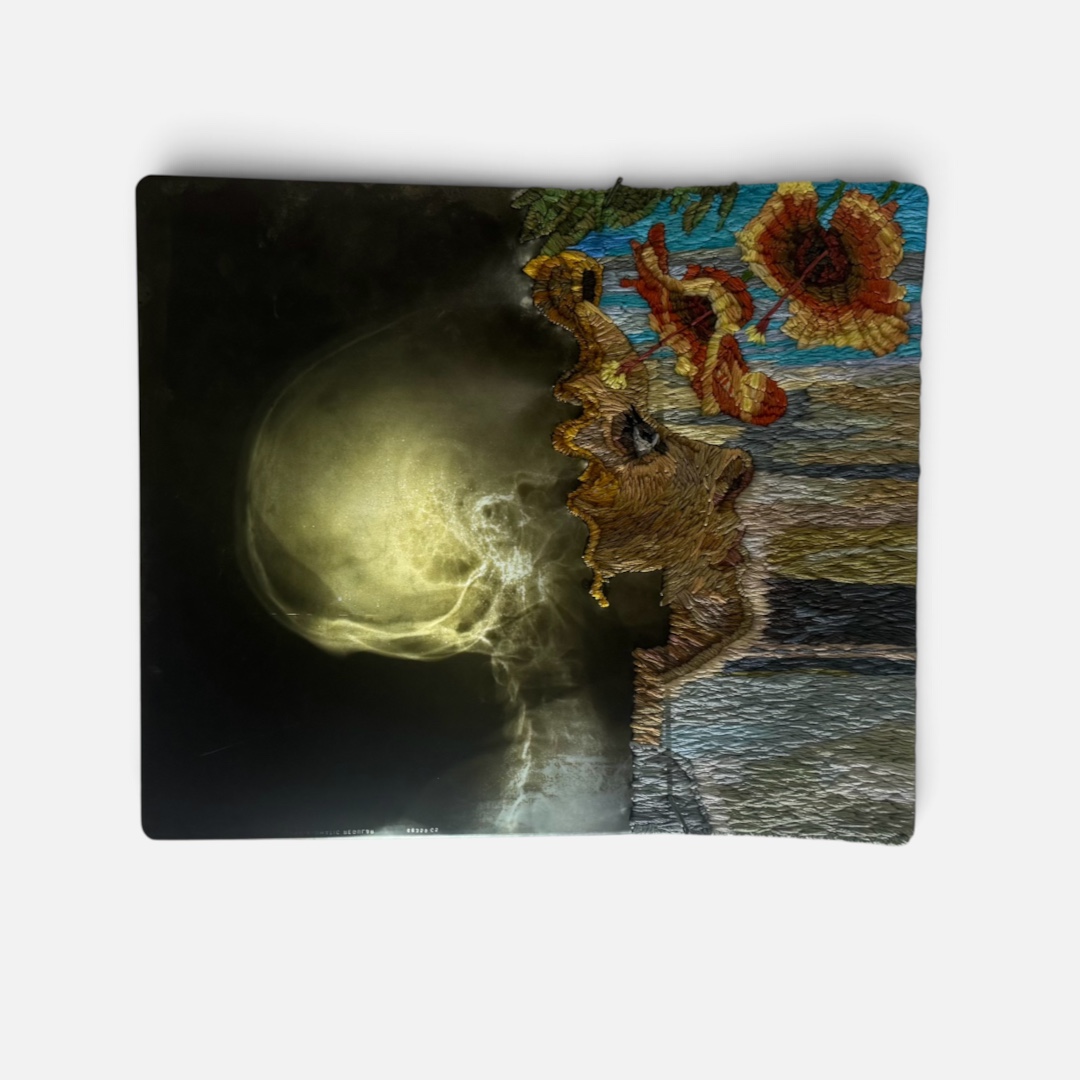
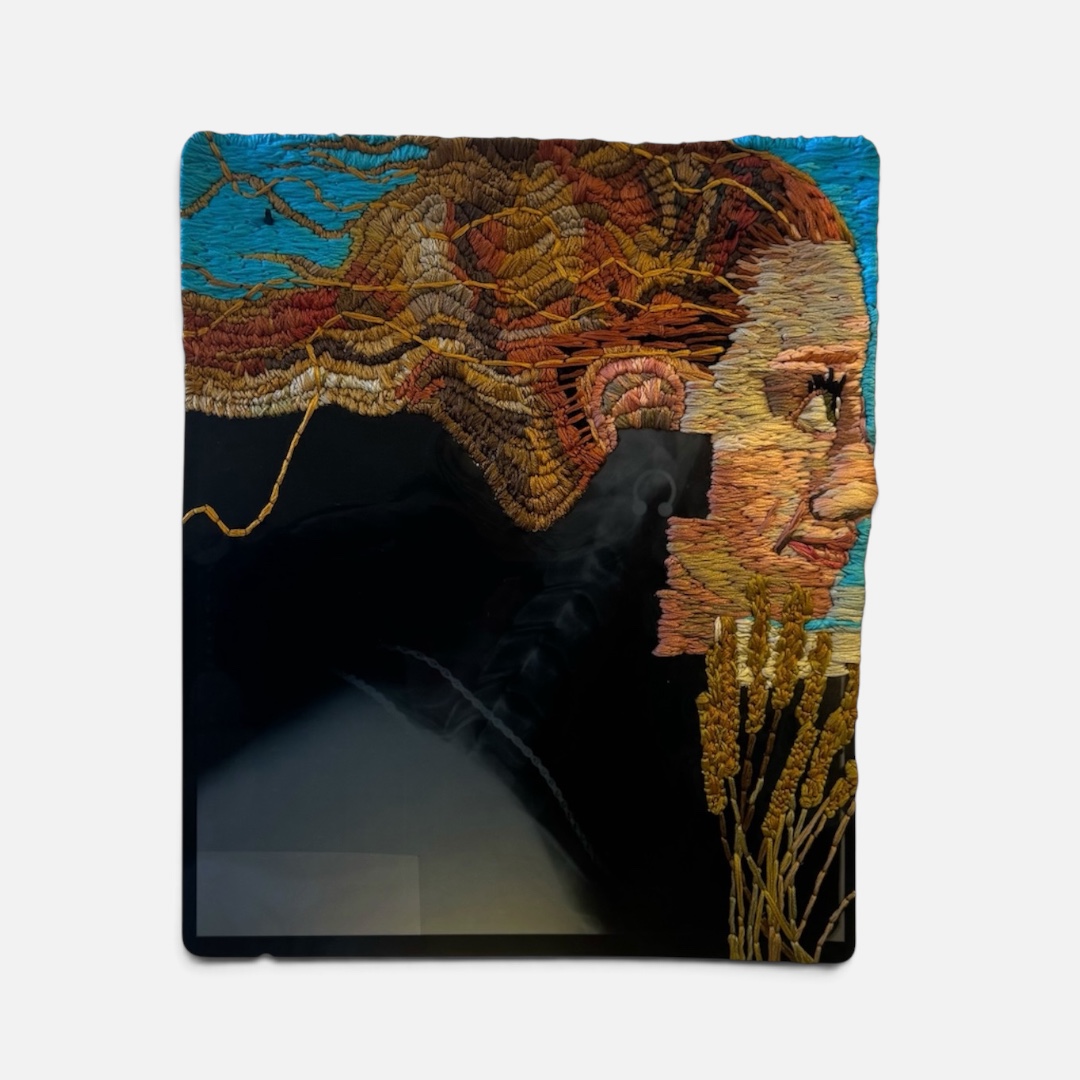
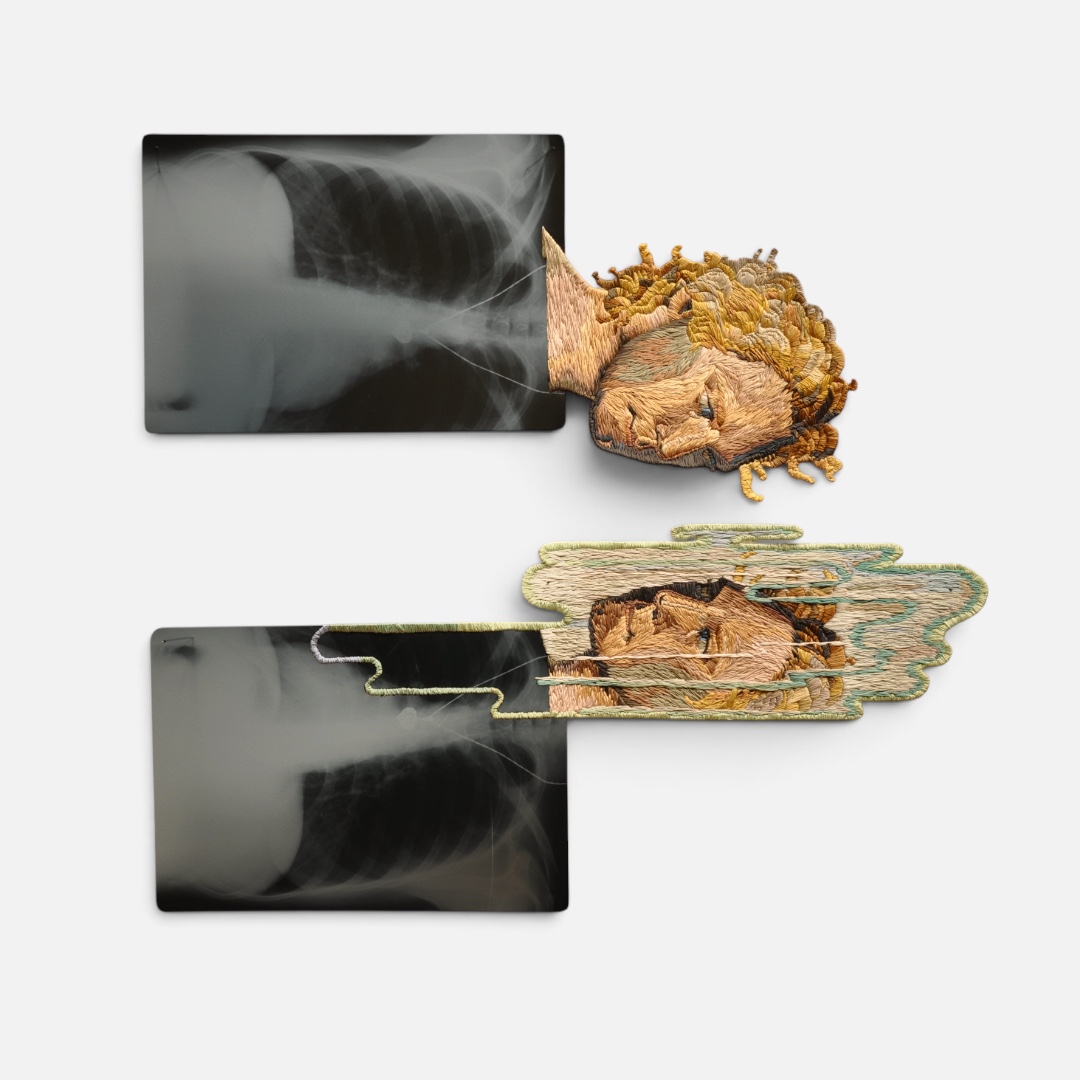
Matthew Cox textile art features hand embroidery on medical x-rays highlighting the contrast between the two materials from the tactile to the technical. Dividing his time between Long Beach California and Cape Town in South Africa his work touches on memory, fragility and care with a sprinkling of pop culture.
What is your background in textiles?
My art training was at Parsons School of Design NYC and Otis Parsons LA where I was an illustration major. I have no formal training in textile. However, my mother was a quilt maker and it was my job to mark the patterns for the design on the stretched quilt with chalk. I never did any of the stitching but gained respect for this labor-intensive project. Embroidering X-rays requires lots of patience and time. I’ve developed an attitude of ‘anything worth doing is worth the time it requires.’
What is it about textiles that appeals to you?
The tactile softness and nurturing comfort of textile appeals to me.
How do you describe your art?
A juxtaposition of two divergent media, x-ray film, blue, cold and medically practical, and colorful embroidery thread, decorative and almost grandmotherly in its application.
Can you explain about your ‘journey’ with your x-rays?
My first embroidered X-ray was made in 2001 and shown in New Orleans in my first solo exhibition. The X-rays were a side note to paintings, watercolors and my rubber stamp drawings. I stepped away from embroidery for a while because sitting and sewing is not a natural action for me. I prefer more physical art-making. However, I returned to it because I still have things to say with embroidered X-rays.
Where do you acquire your x-rays from?
Most of my X-rays have come from two sources: doctors and relatives who live in Australia where there is socialized medicine. There, medical professionals hand the patient their X-rays to keep. Most Australians have a thick stack of X-rays to donate.
How do you sew on the x-rays without damaging them?
X-rays are very tough so damaging them is not easy with the exception of water or tape.
Where are you based and where do you work?
I live and work between Long Beach California and Cape Town in South Africa. I buy old properties to renovate and use them as studios.
How do you work?
Most of my imagery is stored in my head. I have the good fortune of visual memory. However, sometimes I need to study an object that is not familiar to me. For example, I recently painted a painting that included an egg carton. Inspection of an egg carton was needed.
How long does one piece generally take?
Each x-ray usually requires about three weeks.
What have been your career highlights so far?
I’ve had many highlights so far in my career. Several prominent collections have acquired my work. But what really excites me is standing back at a gallery opening or art fair and watching people first notice an embroidered x-ray and then move closer and smile with the discovery of a new, odd object.
Do you have any tips for aspiring textile artists?
My advice for any artist is put in as much time as it takes to make the object interesting.
Is there anything you would like to add?
If anyone reading this has x-rays to donate please do. They have become obsolete and I’d be super appreciative.
Matthew Cox will have a solo show at Paradigm Gallery in Philadelphia https://www.paradigmarts.org in December 2026.