
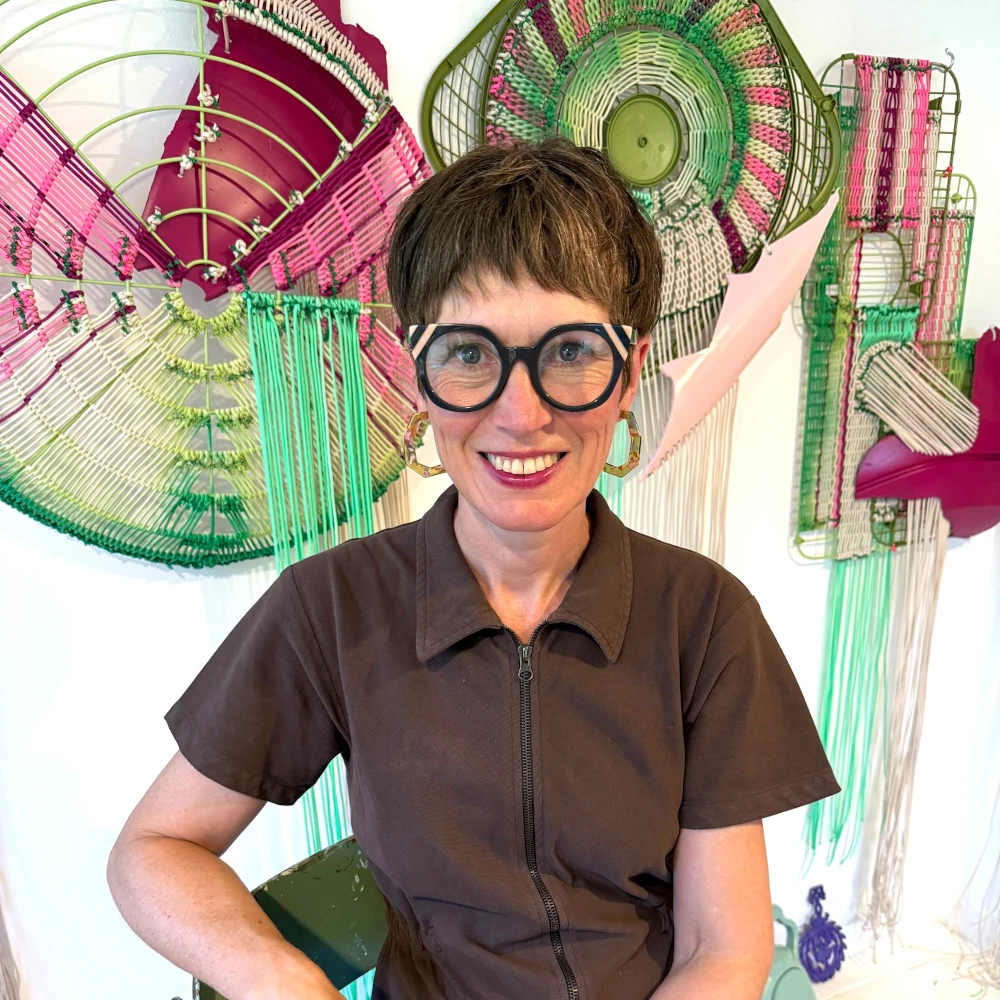

Portal 01 (Objects of Beauty) (2024)
69 x 57 x 8 inches
Assorted objects/fragments found along roadsides and in ditches, paint, paracord, zip ties
photo credit: Seth Dahlseid

Portal 02 (Objects of Beauty) (2024)
70 x 41 x 9 inches
Assorted objects/fragments found along roadsides and in ditches, paint, paracord, zip ties
photo credit: Seth Dahlseid

Portal 03 (Objects of Beauty) (2024)
74 x 52 x 16 inches
Assorted objects/fragments found along roadsides and in ditches, paint, paracord, zip ties
photo credit: Seth Dahlseid

Adorned Obsolescence 05 (2022)
60 x 46 x 7 inches
assorted found objects, rope, paracord, zip ties, paint, and other mixed media
photo credit: Chris Outred

Adorned Obsolescence 04 (2022)
60 x 46 x 7 inches
assorted found objects, rope, paracord, zip ties, paint, and other mixed media
photo credit: Chris Outred

Adorned Obsolescence 02 (2022)
52 x 47 x 8 inches
assorted found objects, rope, paracord, zip ties, paint, and other mixed media
photo credit: Chris Outred

Adorned Obsolescence 03 (2022)
57 x 40 x 8 inches
assorted found objects, rope, paracord, zip ties, paint, and other mixed media
photo credit: Chris Outred

Architectural Hyperbole 01 (2021)
65 x 40 x 6 inches
assorted found objects, rope, paracord, zip ties, paint, and other mixed media
photo credit: John Dooley

Architectural Hyperbole 04 (2021)
72 x 42 x 6 inches
assorted found objects, rope, paracord, zip ties, paint, and other mixed media
photo credit: John Dooley
Firstly where did you grow up and where do you live now?
I grew up in Bloomington, Minnesota–a suburb of Minneapolis. After moving around a bit when I was younger, I ended up finding a college teaching job at Minnesota State University-Mankato. I have lived in the tiny southern Minnesota town of Good Thunder, MN (population around 600 people) for the past two decades. Rural southern Minnesota is certainly not where I saw myself living when I was first starting out as an artist. Even after all these years, I feel most comfortable in big cities…but I’ve grown to love it here, too. There is a different sense of space and time that can be conducive to making work, and I have tried to embrace that.
What is your background in textiles?
I have no formal background in textiles! My academic degrees include an undergraduate degree in Painting from the Rhode Island School of Design, and a graduate degree in Painting & Drawing from the University of Minnesota. However, from the time I was an undergraduate student, I was very interested in painting as an expanded practice that included diverse material sensibilities. I can’t sew at all, but for as long as I can remember, I’ve been interested in clothing and fabric. As a graduate student at The University of Minnesota, I took courses on the history of dress. It seems only natural that for most of my art career, fabric, rope, and other textile materials have played a primary role in my work.
What is it about textiles as an art form that appeals to you?
I am drawn to textiles for their architectural potential, strength, tactility, and malleability. Textiles can be incredibly tough and durable, but are also extremely flexible.
Why do you use knotting and weaving as your main techniques?
I’d been creating large-scale, site-specific installations for quite a few years before I started paying attention to the fact that I was tying hundreds of knots for each installation. The knots were comprised of fishing line and formed a kind of invisible “rigging” that allowed elements to magically hang from the ceiling of exhibition spaces. When my use of fishing line evolved to brightly colored paracord, my knotting was suddenly visible. At that juncture, I became so fascinated with the knotting, a formerly overlooked part of my work, that I abandoned other parts of my art practice to pursue it full-time!
Although I have tried to learn specific types of knots, most of the knots I make are quite simple and very improvisational. There are cable ties on the ends of many of the knots, another holdover from my years of making sculptural installations. I could never get the knots to stay in place, so I would put plastic cable ties on the ends.
I love the fact that knotting is decorative, but also functional. There is a kind of emphatic weight to knotting that I find beautiful and intense. There is an urgency to knotting. I’ve also been “weaving” rope and cord through various materials, and I feel the same sense of purpose and intensity in that process.
My practice has also expanded to integrate a lot of weaving, albeit not the kind of fine weaving exemplified in more traditional textiles. The impetus for the woven interludes in my work really echoes and expands upon the way I am using the knotting. By weaving paracord through found objects, I am able to adorn, strengthen, and play off of objects’ existing patterns and structures.
What other textile techniques do you use?
The textile “techniques” in my work are highly improvised. For a long time, I was afraid to show true textile and fiber artists what I was doing. Now, I am excited about how technique, improvisation, and ad-hoc ways of making can collide. I am currently integrating abandoned, discarded, and overlooked everyday objects and using these as a structure through which to weave rope and cord. The act of intricately adorning these banal remnants of our contemporary life is very satisfying, as is the play between hard and soft materials.
How do you describe your work?
In my wall-based works and installation environments, I explore our relationship to everyday objects, and the ways in which such objects can harbor individual stories as well as revealing collective histories. Objects found in thrifts stores and along the side of the road become armatures for ad-hoc weaving, knotting, and embellishment with rope, cord, and other textile materials.
I create interdependent knotted and woven topographies that allude to both structure and malleability while recognizing and elevating aspects of human culture that are neglected, overlooked, or discarded. The repeated act of hand tying and weaving integrates an emphatic sense of strength, while the flexibility and nuance of the textile material ensures permutations. Although my work is abstract in nature, the found objects ground the abstraction in an undeniable physical reality, and the juxtaposition of the concrete and the abstract creates a poetic sensibility in both the process and the finished work. Together, the poetic and concrete speak to abandonment, consumerism, loss, love, and redemption.
The color in my work has usually been largely intuitive. I love playing with the seductive and decorative qualities of bright colors as well as how those same colors can become excessive or discordant. I have been experimenting with some subtle symbolic color in the newest work (I talk about this in the next section of this interview!)
How do you create a piece?
My process is really driven by materials. I don’t do sketches or models or mock-ups, but I will spend many hours looking for the right materials to begin a work.
The found objects I’ve been integrating guide the form that the textile adornment takes–so finding objects is imperative. Initially, almost any found object could be integrated. More recently, I’ve been focusing on abandoned objects culled from the roadsides and ditches where I live…and beyond. I hope to collect objects from all 48 contiguous U.S. states to be integrated in new works. This summer, with the support of a research grant from the university where I teach, I was able to collect objects from sixteen states. Only 32 states to go! Without the objects, I can’t begin the process in the studio. I’ve been playing with connecting the woven and painted elements to the colors of the state flowers where each object was located.
I know this is a hard question but how long does a bigger piece take?
That is a hard question! I often create wall-based works in a series, so I am focusing on multiple works at any given moment. Generally, a larger group of wall works, or a site-specific installation, can take months (or even over a year) for me to develop. The most recent works I’ve completed, as alluded to earlier, involve a lot of time locating found objects. This effort has been rewarding, but it certainly adds to the total time required to make a work, as it’s not just time in the studio—it is also time scouring the local, regional, and national landscape to locate abandoned objects. Sometimes it is a little frustrating to spend so much time outside the studio. But I tell myself that art is long, and I’ve always tried to step up to the demands of my practice.
What are you most proud of in your art career so far?
One of my recent and most memorable career highlights was receiving a 2020 McKnight Foundation Fellowship for Fiber Artists. The fellowship is intended for mid-career fiber artists based in Minnesota, and it includes a $25000 unrestricted award. It meant a great deal to me to be recognized for the experimental work I’ve done in fibers over the past two decades, and it helped connect me to an amazing community of fiber and textile artists from around the world.
Do you have any advice for aspiring textile artists?
As someone who came to textiles from a non-textiles background, I would tell aspiring textile artists (or any artists!) to not be afraid to embrace what makes you and your work unique. The very things that I felt made me an outsider within the textile community were what have allowed me to bring a unique sensibility and vision.