
SERE ISLA: FOR ZILIA SANCHEZ (2024)
55″ x 30″ x 18″
15oz Duck Canvas

DON’T TRIP OVER MY LINE IN THE SAND (2024)
45″ x 37″ x 12.5″
18oz Duck Canvas

SERE ISLA: FOR ZILIA SANCHEZ (2024)
55″ x 30″ x 18″
15oz Duck Canvas
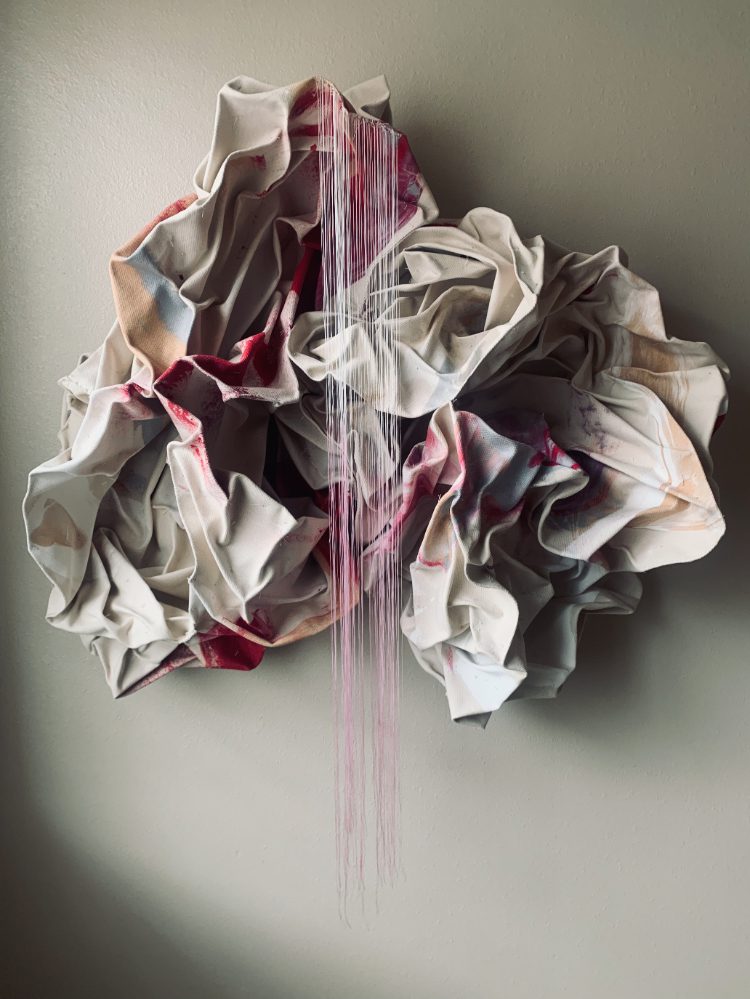
YOU CAN BE YOUR OWN MESSIAH (2024)
40″ x 48″ x 15″
15oz Duck Canvas

I DIED THAT DAY (2024)
48″ x 37″ x 13″
21oz Duck Canvas

SONATINE I (2024)
35″ x 26″ x 16″
21oz Duck Canvas

YOU CAN UNDREAM THE FEAR (2024)
47″ x 30″ x .11″
21oz Duck Canvas

WALK THROUGH THE MOUNTAIN (2024)
43″ x 23″ x 20″
21oz Duck Canvas

YOU CANNOT KILL ME (2024)
58″ x 29″ x 11.5″
21oz Duck Canvas

There is nothing supreme. There is nothing more profound. Than being with you here, right now (2024)
27″ x 44″ x .15″
21oz Duck Canvas
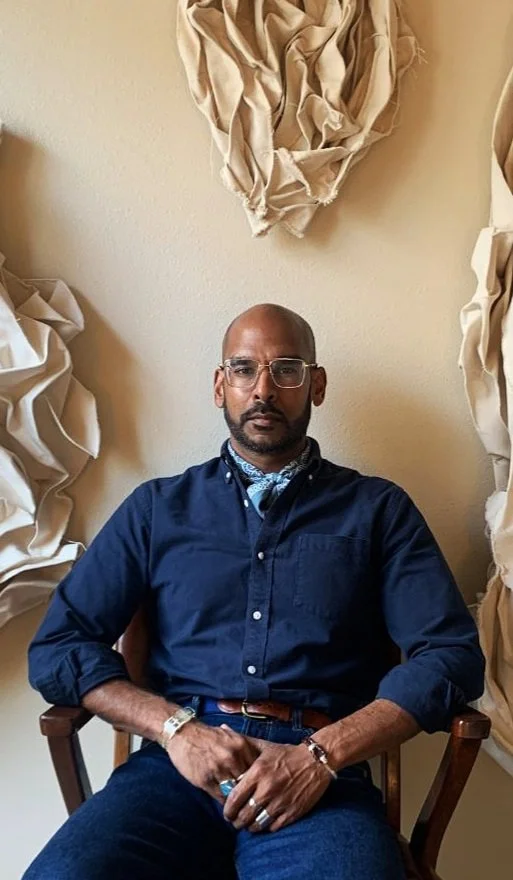
Simplicity, form and texture combine in Australian textile artist Kent O’Doherty’s sculptures. Centering around how bodies hold memories, his pieces are constructed with duck canvas and stitch. Light and shadow accentuate the organic shapes which evoke a feeling of serenity, drawing the viewer into contemplation. Kent is based in Seattle.
Where are you from and where do you live now?
I am a first generation Australian, from Melbourne. I have lived in The Netherlands and now in America. My wife and I have moved around quite a lot (Boston, North Carolina, New York, Connecticut, California), and we now live in Seattle.
What are your earliest memories of art or textiles?
My childhood home up had a lot of paintings and small sculptures – mainly reproductions of famous classical artworks. Looking back it was nice to have them around, but I did not connect with them. My first real memory of truly seeing art is from when I was 10 or 11 – from a book that was being sold in a bargain bin at a supermarket. The book’s subject was art from the 20th century. I just happened to open to a page on Jackson Pollock and thought to myself, “this is art”. His work was not a painting of a person, or a chair, or a landscape; it was a painting of art itself. I do remember feeling that I understood what the painting meant, whatever it could mean at least to a young kid.
Textiles and cloth have been extremely important for as long as I can remember – with clothing really being the centre of the interest. What I wore and its texture was of great concern to five-year-old Kent…no corduroy thank you! I did love the black, pink and gold sweater with faux silk elbow patches though. This interest has only expanded as I have gotten older. There are lovely memories of my grandfather’s silk smoking robe, how even in summer it was cool to the touch. Memories of fabric run as deep as anything else…
Music has played a big part in your life, did you do music and art simultaneously?
Growing up there was no distinction for me between music and art, I would move between and combine them freely – art for me though meant painting and drawing exclusively. Moving away from music though has been a long process, but ultimately an incredibly freeing one. When one has experience and reached a certain level it can be very difficult to walk away, despite a sense of dissatisfaction. When I started textile art I was searching for deeper textures of shadow and light that painting simply could not offer. I started sewing and thought that it was almost too enjoyable….isn’t art all about the struggle? At least that was the narrative I was fed and feeding myself within music making.
What is your background in textiles?
I am self-taught…The only thing(s) I sewed prior to starting were buttons on clothing.
How do you describe your work?
I think of them as modern, abstract sculptures
How do you create a piece?
The beginning is a length a fabric that will not be cut throughout the making process – that’s important for me. There are not any sketches or any other predetermined ideas. I’ll start moving the fabric around and doing some preliminary stitches, broad strokes as it were. Everything is hand-stitched with nylon thread for strength. The general shape of the piece will then jump out at me and I will follow that until the next direction come along. To be honest, it feels as though I am being pulled/guided through the making, as though someone has a hold of my hand. Foundational stitches are done along side more aesthetic ones as I prefer to not have a set workflow. I take photos throughout the making process as I can be more objective and critical of what I feel needs to happen. I can see the shadow and light interplay much better in a photo for whatever reason. The finishing of a piece is pretty anti-climactic, with the piece telling me that there’s nothing more to do.
Do you work exclusively with duck canvas or do you use other materials?
I do work exclusively with Duck Canvas. It’s the only material that I have found that has the stiffness yet malleability that I need, of course there most likely are other fabrics that could work with which I am not familiar. After using duck canvas alone for some time, I am now using acrylic paint and a sealant on all the works. Of course, there is another layer of expression in using the paint which is nice. The dynamic of the fabric does change, not necessarily stiffer, but it allows me to have more agency with regard to how many stitches are needed to hold the shapes in place. It has balanced the artistic and technical sides of the process.
What appeals to you about duck canvas?
I like the colour and tone of natural duck canvas – it shows light and shadow very well. After being a musician and needing all the equipment, whether for acoustic performance or electronic music production, it is nice only needing a length of fabric and thread to make a piece. I do enjoy making my work with the fabric (or at least cousin of) which painters have used for hundreds of years. Using the fabric that both helped people sail around the world and is used to protect one’s floor when painting a wall speaks to duck’s varied appeal. It’s often the most humble of things that find their way into all the corners of people’s lives.
How do you come up with the interesting titles?
My titles have come from different sources. I went through a period where a lot of personal matters were being resolved. All the pieces from the HERE | NOW series are titled with respect to those events and their closure.
For works from THE VALLEY series, titles were given to each piece after completion. I would hang the piece and view it for a week or two – slowly, some blank verse would come to me (a writing style I used a lot in my younger days) and the piece would get its name.
I am now using musical genres and forms as my titles. My work has moved away from being narrative in intention to something beyond. I desired for a naming convention that communicated me (my past as a professional musician), whilst allowing the piece to do the heavy lifting with regards to expression.
Do you have any advice for aspiring textile artists?
If you are thinking about starting, please do….don’t wait. I started on a $22 investment, with it being the best money I’ve ever spent. Be honest with yourself about the process of making – do you actually like the process? If you don’t, then do not push yourself to pretend. If you are able to reach your version of success, that most likely means living in the process even more than you already are, and that’s a miserable self-built prison to be in. Results are nice, but the process is your daily life.
A big one for me is not having to justify why you have made something the way you have made it. Everything these days needs data to justify its existence. We are artists not scientists (though there can be some wonderful crossing over). Do not feel the need to justify what you are doing to people who are really looking for validation of their way of doing things. As artists we cannot really even explain where our making originates from…and why should we bother? Make your work with all your force, with openness & honesty and do not compromise.
Is there anything you would like to add?
Ask yourself if you would want to view your pieces in a gallery/museum. Would you want to purchase your work? These two reflections can really help get you where you want to be in terms of the work you are producing. I made a lot of music back in the day that I was very good at, but had no desire to ever listen to. I was able to sustain that lifestyle for a while before the inevitable crash – living with honesty sounds easy doesn’t it?