
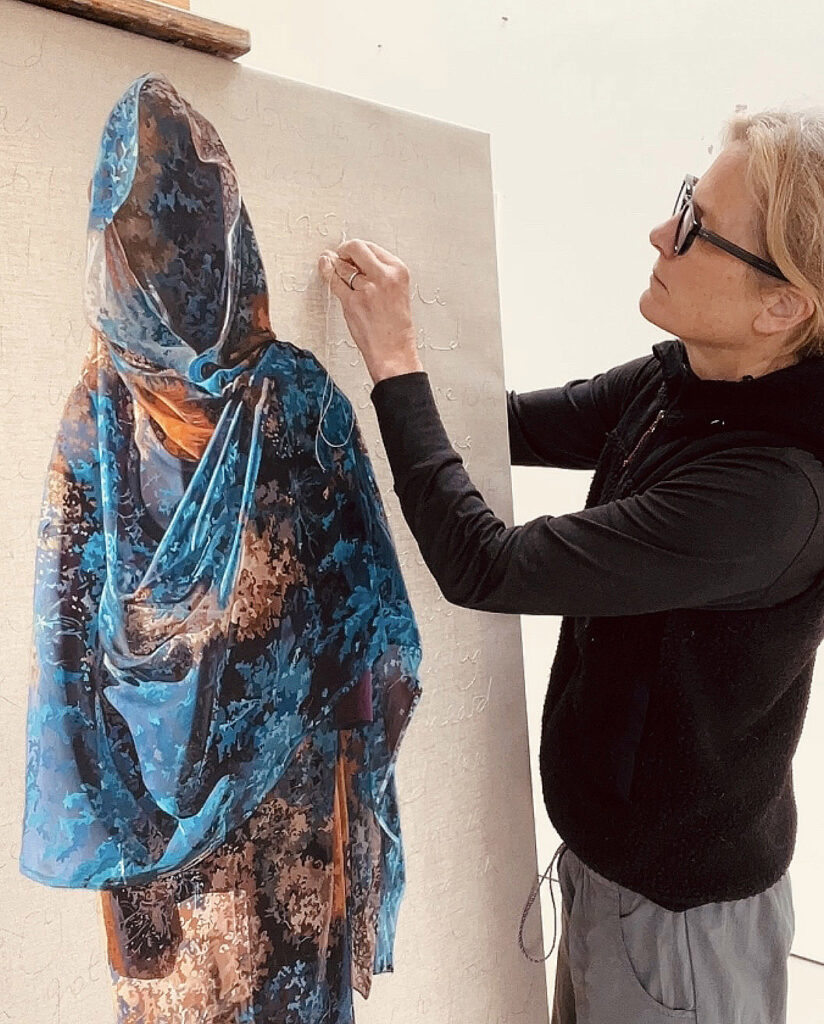

Basic Values are Universal (2025)
85x70cm
Oil paint, cotton embroidery thread

Life Deserves to be Lived (2026)
130x85cm
Oil paint, cotton embroidery thread

Life Deserves to be Lived detail (2026)
130x85cm
Oil paint, cotton embroidery thread

Home is Wherever My Daughter Is (2025)
120x80cm
Oil paint, cotton embroidery thread

Everyone is Trying to Make the Best of Their Own Situation (2024)
110x75cm
Oil paint, cotton embroidery thread

Everyone is Trying to Make the Best of Their Own Situation detail (2024)
110x75cm
Oil paint, cotton embroidery thread

Home is Wherever My Daughter Is detail (2025)
120x80cm
Oil paint, cotton embroidery thread

I Will Not Give Up on the Kindness of People (2023)
120x80cm
Oil paint, cotton embroidery thread

I Will Not Give Up on the Kindness of People detail (2023)
120x80cm
Oil paint, cotton embroidery thread
Julia Hall is a British artist who combines figurative oil painting and hand embroidery. She works in series conducting extensive research for each body of work which include MATRIARCHY and REFUGE. ‘I increasingly feel that thread symbolises a web of inter-related ideas and basic human values, with historical and global reach.’
Where were you born and where do you live now?
I was born in South Devon and have been fortunate to live in many different countries before returning to North Devon with my family, which is where I now have my studio.
What are your first memories of creating with or being around textiles?
I come from a family of practical makers and menders, surrounded by women and men who constantly have busy hands. My grandmother had a ‘craft room’ in her house and was always making or knitting. My mother taught me to sew clothes from a pattern. When I was a young child, my father had a business making bean-bag dog beds from a shed in our garden, using a sewing machine all day. Later he became a Design Technology teacher, so there were always projects happening. We were expected to make presents for people, rather than buy them – that really encourages creativity.
What was you journey to becoming an artist?
Crafting, drawing and reading were my main hobbies as a child. I was always sketching, and enjoyed graphic design and lettering, but never really saw it as a career direction. I was quite academic at school, and loved History as a subject, so studying that at Somerville College, Oxford was a natural progression. I was also a student in the 1990s, and the only artists getting attention were the YBAs. It seemed to me that to be an artist meant being angst-ridden and shocking, which didn’t fit with my personality! I struggled to find a career direction after graduating, mostly because I ended up moving country every couple of years. I had three children and when my youngest started nursery I decided to really explore art in various forms. I enrolled in adult education classes at City Lit, in London and by the time my husband’s job took us to New York, I knew I wanted to enrol in academy style classes to learn figurative oil painting. I was fitting those around the school day, slowly building up my skill level. When we moved to Devon in 2014, I set up my studio and was able to start working full time as an artist. It was through taking part in the year-long, Porthmeor Programme, at St Ives School of Painting in 2017/18 that I really started to understand how to find a voice through my work. I gave myself more permission to experiment that year and started combining textiles with the oil painting.
How do you describe your work?
The work is a combination of figurative oil painting and hand embroidery. My practice is often motivated by a desire to slow down and take a longer view of the human experience. It is infused with my interest in history, and a desire to search out the threads which connect us.
What techniques and materials do you use?
Oil paints usually on clear-primed linen canvas, with cotton embroidery thread. I often use split-stitch for lettering, sometimes a kind of weaving with thread and free ‘thread drawing’ to highlight parts of a painting. Your art is predominantly painted, why do you add hand embroidery? With a background in both painting and sewing, I became interested in the relative history of both techniques. Embroidery had been highly valued in the Middle Ages and created by men and women. After the Renaissance, oil painting took precedence and became the valued domain of men, while embroidery became a domestic female craft. At a basic level, they are both a way of decorating on cloth, so by combining the two techniques I feel I am helping to reclaim a space for embroidery and ‘craft’ in the art world. My first dresses project – MATRIARCHY – was inspired by my genealogist grandfather. He meticulously researched our family history, but as an adult I realised it was the essence of patriarchy, showing an unbroken line of male family members. In the absence of passing on their family name, the women in my family have passed the traditions of sewing and crafting. The hanging threads in the works speak to an alternative family tree, and connections through the centuries. As my work around the stories of women has progressed, I increasingly feel that thread symbolises a web of inter-related ideas and basic human values, with historical and global reach.
How do you create a piece?
I do extensive research before I start a project. I can be thinking about it for a couple of years, reading around the subject, listening to podcasts, visiting museums and galleries. Ideas will form while working on a previous series. The seeds are often sown by examining my own response and prejudices to a topic of conversation I might hear on the radio or in a podcast. Once I have a good idea of what I want to say through the work, I will do some drawings and test pieces of painting and embroidery. For my REFUGE series I have also interviewed the 15 women included in the project, which involved a lot of work to find people who were willing to be involved and visiting them around the country. I always paint on the canvas first then wait for that to dry before I embroider.
Do you always create series of works? If you do, why does this appeal to you?
My work is always project-based. I am often exploring a topic or an idea, with the purpose of learning something new, encouraging us all to take another look, to slow down our reactions. Having a series of work enables me to give multiple points of view based around a central concept and to add layers of meaning and complexity. It can feel like creating a chapter in a book with each new painting.
How long does a piece take to create?
Each dress piece takes about six weeks to create.
How has your work evolved over time?
My early work was very much related to me and my family. It has now evolved to a point where I want it to serve more of a purpose. I am intensely curious about people – human lives, the differences and similarities between us. My work is an antidote to the short-term, divisive and alienating effect of the frenetic contemporary media coverage of current events, and I am increasingly leaning into that. After spending three weeks on a residency in France earlier this year, I am currently working on a new project around polarisation and connection. I am experimenting with new forms of embroidery and ideas around tapestry and visible mending.
What is your proudest career moment so far?
My proudest moment was watching people respond emotionally to the first eight pieces in my REFUGE project when they were shown together at Collect in 2024. It was also very moving to have many of the women I interviewed come and see the work. More recently I have had a piece installed for a couple of years at the Ashmolean Museum in Oxford, based around a Syrian woman who arrived in the city in 2016.
Do you have any advice for aspiring textile artists?
Like any art form I would encourage people to experiment, learn new skills and be curious about the history of textiles and textile art. Go and wonder at the Syon Cope and other medieval examples of Opus Anglicanum in the Medieval Galleries at the Victoria and Albert Museum, London. Read The Subversive Stitch by Rozsika Parker and Threads of Life by Clare Hunter. We are all finding a tiny niche in a long and wonderful tradition. Also find a practice and purpose which fulfils you in the long term. Being an artist is a marathon not a sprint, and you must love what you do.
Julia Hall is represented by Alveston Gallery, London. https://www.alveston.london/
‘No One has an Umbrella Above Their Head’ is exhibiting at The Ancient Middle East gallery, at the Ashmolean Museum, Oxford. https://www.ashmolean.org/
Other work can be seen at Alveston Gallery