

hospital landscape (2015)
140 x 160 x 10 cm
reclaimed yarns

don’t be afraid, it won’t bite (2016)
140 x 190 cm
reclaimed fabrics, knitwear fragments,, crochet thread, cotton lace, threads, leather gloves, tights

the feeders (2016)
208 x 210 x 20 cm
reclaimed yarns

crane mother (2014)
Ø 135cm
reclaimed fabrics, threads, painting loom

difficult age (2026)
250 x 200 x 2 cm
reclaimed fabrics, threads, cotton lace, foam, snap fasteners, zipper

seascape (2024)
117 x 130 cm
reclaimed fabrics and yarns

finding order (2026)
triptyh Ø 25 cm, Ø 15 cm, Ø 20 cm
linen fabric, threads, cotton piping and lace, acrylic yarn, embroidery floss, painting loom

Kora vs Persephone (2025)
Ø 45 cm
reclaimed fabrics, embroidery floss, threads, painting loom

without a trace (2025)
87 × 176 cm
reclaimed fabrics, knitwear fragments, woollen felt, faux leather, embroidery floss, cotton lace, threads
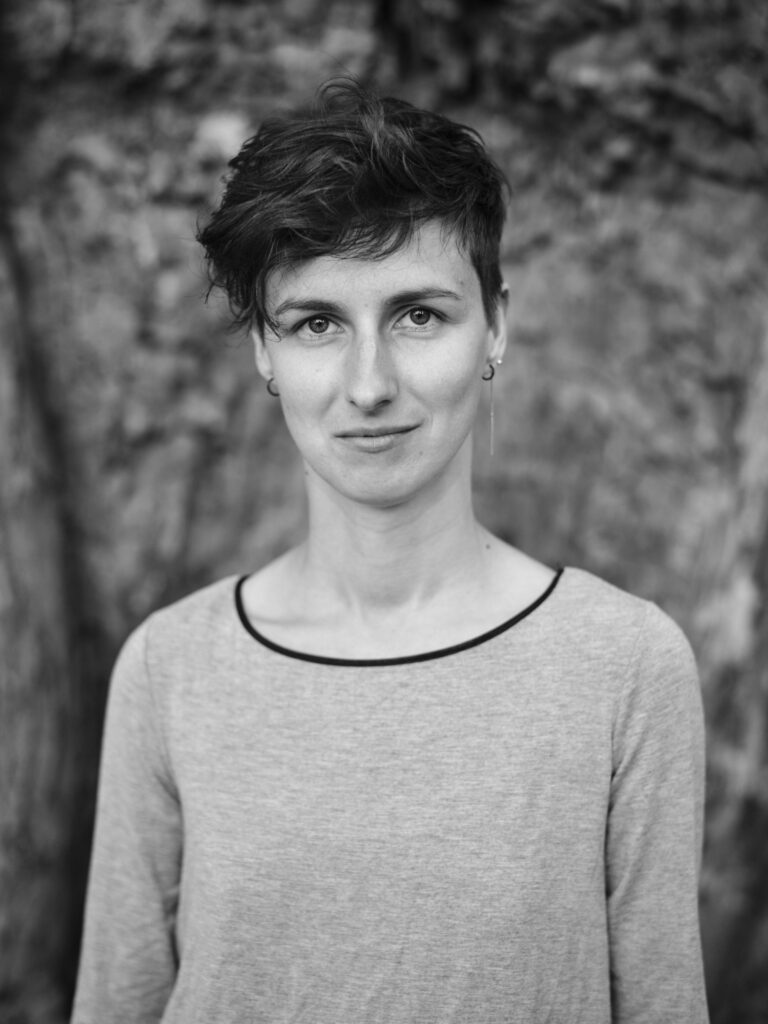
Anna Przybyło is a Polish textile artist based in Kraków. Her themes stem from personal experiences and materials often include found materials, remnants and textile waste. Currently her process centres on appliqué and, at times, incorporates weaving or crochet to build layered wall art and sculptures. “Making work is a way of closely observing the full spectrum of experience: from tenderness and intimacy to tension, fear and transformation.”
Where were you born and where do you live now?
I was born in Nisko, a small town in south-eastern Poland. Since graduating, I have lived and worked in Kraków.
What are your first memories of making with textiles?
My first encounter with textiles was learning to sew on a sewing machine and knit when I was in high school. I always struggled to find clothes that fitted me properly, so I learned to make them myself. Later, while studying at art school, those skills allowed me to start sewing my sculptural works without hesitation. Around the same time, I also learned weaving and crochet, which gradually became an important part of my practice.
Where did you study textiles?
I studied Sculpture at the Academy of Fine Arts in Kraków. During my studies, I followed an individual study programme that allowed me to join the textile studio, where I learned weaving and crochet. That experience gave me much more than new techniques. It showed me how broad and open the field of textile art can be. From that moment on, textiles gradually became my primary sculptural material.
What appeals to you about using textiles in your practice?
What fascinates me most is their incredible diversity. The range of textures, structures and colours offers endless possibilities, and I love working with that richness. Although I trained as a sculptor, colour has always been just as important to me as form and structure. Textiles bring all of these qualities together. They are highly tactile, full of colour, and at the same time easy to shape and preserve. They are also relatively light and clean to work with, which has allowed me to create even large-scale pieces without having a dedicated studio.
How do you describe your work?
I mainly create wall-based compositions — paintings made of textiles. In my most recent works I increasingly move into three-dimensional space.
My work grows out of experience, both personal and universal. This is why I am so drawn to archetypes, symbols and myths across different cultures and civilisations. What feels most present in my work at the moment is the idea of transition — between worlds (inner and outer, symbolic and physical, individual and collective experience), but also transition understood as initiation. This includes entering adulthood and parenthood, as well as a deeper process of self-awareness and the acceptance of one’s shadow. For me, making work is a way of closely observing the full spectrum of experience: from tenderness and intimacy to tension, fear and transformation.
What techniques and materials do you use?
I began with traditional weaving, using hand-dyed sisal fibre. Over time, I started to combine different techniques within this material — weaving intertwined with crochet and other experimental, self-developed forms of interlacing. Later, I began working with fabric remnants from clothing production and worn garments that could no longer be used. During my studies, these materials became the basis for my first textile sculptures, and later for textile paintings. I have also worked with copper wire as a weaving material and beyond. In recent years I have expanded my practice to include both hand and machine embroidery. Over time, all these techniques and materials have gradually begun to merge and overlap. At the moment, I work mainly with fabric using appliqué techniques, but I still return to earlier materials and methods from time to time — especially when I want to create unexpected and unconventional combinations.
How do you create a piece?
Usually it begins with an impulse — an idea or a theme. Then I choose a colour palette, which is one of my favourite stages of the process. The materials I select often determine the composition and what will eventually appear in the work. Whenever possible, I try to preserve the original shapes, sizes and textures of the fabrics. I arrange the selected textiles on a fusible interfacing, creating a kind of initial sketch, although I don’t treat it as fixed. During the process I often change my mind, and parts of the composition shift or evolve. The fabrics are then ironed so they bond with the base layer, and afterwards I stitch them using a sewing machine, almost drawing with the stitch across the surface. At times this is the end of the work, and at other times I continue by adding hand embroidery or additional elements.
How long does a piece take?
If I have a clear idea in my mind, I work very quickly and intensively. A large piece can then take around two to three weeks to complete. However, things do not always go that smoothly. Sometimes ideas take a long time to mature, and in those cases the invisible part of the process takes much longer than the actual making. I often feel that this stage lasts even longer than the physical work with the material itself.
How has your work evolved over time?
I believe my work evolves together with me. With new life experiences, a new awareness emerges. My practice has always grown out of deeply personal experiences. At first, these were intimate relationships, then motherhood and the social phenomena connected to it, and now it is centred around maturation and initiation in a much broader sense. From the time of my studies, I have been drawn to symbols. I often referred to
literature in my work, finding in it universal truths that also reflected my own experience. I turned to archetypes, and more recently to different mythologies, especially the myth of the Great Goddess Inanna. In it, I found many of the themes I am currently exploring: initiation, the acceptance of the shadow, the duality of feminine nature, cyclicality, and the stages of life.
What is your proudest career moment so far?
A turning point in my career was receiving the Grand Prix at the 2nd Textile Art Biennale in Poznań. After this recognition, I felt that many doors began to open. It led to exhibition opportunities, including at the National Museum in Jakarta and MOCAK – Museum of Contemporary Art in Kraków. The winning work is now part of the collection of the National Museum in Poznań.
Do you have any advice for aspiring textile artists
I believe that in any field of art, the most powerful work is always the most honest. Textiles have the advantage of being an extremely versatile medium. Through them, it is possible to express and communicate a great deal. I am convinced that anyone who wants to work with textiles will find a technique that resonates with their interests and temperament.
Is there anything else you would like to add?
I like to think of art as a space for encounter rather than an exam in knowledge. There is no need to always know “what the artist meant”. Sometimes it is enough to follow one’s own associations and not assume in advance that something is incomprehensible. There is no single correct way to experience art. I am very curious about how someone who does not know me interprets my work through their own experiences. Often, these interpretations reveal things I had not noticed myself. I believe that what is non-literal leaves space for imagination. And it is precisely for this reason that contemporary art can feel close to everyone.