


Untitled (2024)
cotton, cotton muslin, cotton thread, silk thread, ceramic
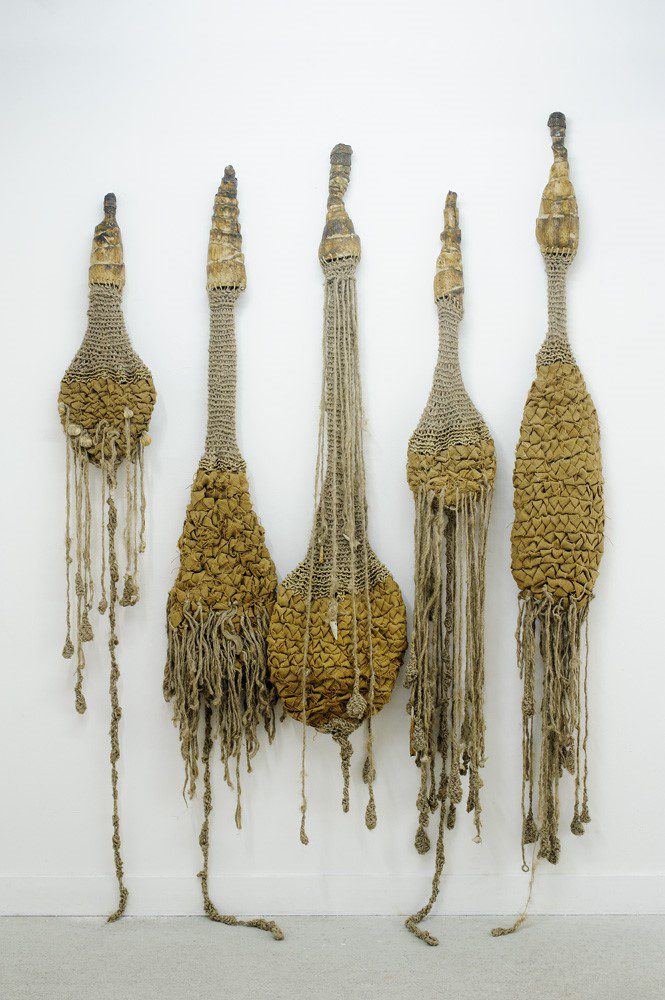
Untitled (2019)
Height: 200 cm Width: 200 cm Depth: 70 cm
material: burlap, linen twine, ceramic

Untitled (2025)
Height: 210 cm Width: 300 cm Depth: 45 cm
cotton, leather, cotton thread, silk thread, ceramic
Photograph : Nathalie Desormeaux

Untitled (2025)
Height: 190 cm Width: 120 cm Depth: 35 cm
cotton, cotton muslin, cotton thread, silk thread, wood, ceramic
Photograph : Nathalie Desormeaux

Untitled (2024)
Height: 200 cm Width: 250 cm Depth: 30 cm
cotton, cotton muslin, silk thread, ceramic

Untitled (2019)
Left: Height: 170 cm Width: 80 cm Depth: 60 cm
burlap, raffia, plant-based linen string, ceramic
Right: Height: 200 cm Width: 200 cm Depth: 70 cm
burlap, linen twine, ceramic
Photograph : Chalie Adad

Untitled (2020)
WALL Height 220 cm Width: 150 cm) Depth: 50 cm
jute canvas, plants, ceramics
On a base : Diameter: 60 cm Height: 45 cm
linen string, plants, ceramic

Untitled (2018)
Height: 200 cm Width: 200 cm) Depth 30 cm
cotton, jute twine, jute rope, linen tow, ceramic

Untitled (2018)
Height: 150 cm Width: 150 cm Depth: 30 cm
linen string, linen tow, plants, ceramics
French artist Adeline Contreras explores memory through sculptures and installations. Neutral and calming colours allow the material to be the focus of work inviting a tactile relationship with the viewer. Leaving her work untitled allows the viewer to approach it without prior knowledge and unearth forgotten memories and experiences.
Where are you based and where do you work?
I live and work in France, near Lyon, in a small village in the countryside. My studio is located in the heart of the village of Pélussin, within the Pilat Regional Nature Park. Living close to nature is essential for my practice, while being near a major city provides a balance between culture and the natural environment.
What is your background in textiles?
Since I was little, I’ve been immersed in thread. My grandmother was a seamstress, and I spent many hours by her side, watching her at her treadle sewing machine. I would help her prepare and cut fabrics and choose the materials. She had a sure hand and a discerning eye. She taught me a great deal. For the techniques I needed as my practice evolved, I always sought out skilled hands who could teach me—transmission and thread are closely intertwined. It is thanks to these encounters and lessons that I was able to expand my technical repertoire: embroidery, crochet, plant-based dyeing. In my journey, everything is a story of meeting and learning from others.
How do you describe your work?
My work explores sensitive memory and the reminiscences of touch through ceramics and thread and fiber techniques. I create installations and sculptures where materials engage in dialogue to evoke an immersive experience that goes beyond simple visual recognition. The material becomes a vehicle for sensations and buried memories, inviting an intimate, almost tactile relationship with the work.
My approach emphasizes experimentation and transmission: each piece is, for me, a research process, a space of exploration that connects gesture, material, and memory.
Why do you use textiles within your practice?
Textiles occupy a central place in my practice because they carry both material and memory weight. Old fabrics, marked by use and wear, are for me fragments of time already lived. They bear the memory of the gestures that shaped them and the bodies that passed through them. Their texture, alterations, and scars inscribe a silent history that I choose to extend.
In my work, these fabrics are treated as a full-fledged raw material, a malleable substance open to transformation. Their inherent qualities create a field of possibilities: they respond to sculptural intent, being shaped, stretched, assembled, and held in volume. This passage from flexibility to structure, from the formless to form, lies at the heart of my artistic gesture.
For me, textile is a medium of metamorphosis. By embracing traces of the past and giving them a new presence, it links intimate memory with contemporary creation. It becomes an active element, a living material that engages both sight and touch in a sensitive experience of sculpture.
Why is your work untitled?
I don’t give my works titles because I find that it directs the viewer’s gaze too much. I like the idea that someone standing in front of one of my sculptures can approach it without any prior guidance, without a word to steer them towards a single interpretation. I prefer to leave space for that moment of encounter, when the gaze questions, when sensations emerge, when memories are activated.
The absence of titles is a deliberate choice; my work seeks to open up a field of sensitive, intimate, and multiple resonances. I find it interesting to give viewers the freedom to project their own experiences and construct their own narratives when faced with the work.
Can you talk us through how you create a piece?
My creative process is rooted in time and in the repetition of gestures. It all begins with drawing, an essential step that allows me to explore lines, tensions, and volumes in the making. Drawing is a space of research where forms search for themselves before finding their balance. At the same time, I collect raw materials: old textiles, plants, ashes, metal. These materials already carry a history, a lived experience, which I integrate from the very beginning of the process. All elements are organized and cataloged in my studio.
Next comes the selection of a drawing, which becomes the framework for the project. I then prepare each element: shaping the clay, treating its surfaces, applying different firings; cutting, dyeing, sewing, and embroidering the textiles. Each of these elements goes through its own production time, with its constraints and expectations—drying, firing, resting, transformation.
The key moment remains the assembly. It is a time of confrontation and revelation, where the materials meet and find their rightful place in accordance with the initial drawing, to which I remain very faithful. The piece then takes form, in a tension between fragility and balance, between memory and presence. It exists in continuity, while asserting a precise moment—the moment when the gesture finally gives it shape.
How long does a larger piece take to create?
Creating a large-scale work is a long process that involves different temporalities depending on the materials. Ceramics require precise stages of shaping and firing, while textiles follow a more organic rhythm: some fabrics remain for weeks in pits in my garden so that the clay can alter them and partial decomposition occurs. While others dry outdoors for months after dye baths allowing them to undergo the effects of time.
Each element is then carefully prepared: sewing, embroidery… slow, repetitive gestures that inscribe time into the material. Finally comes the moment of assembly, where all these components meet and hold together. Depending on the complexity of the piece, this entire process can take three to six months, sometimes longer. Several works are often in progress simultaneously, each following its own pace and undergoing its own periods of maturation.
What is your career highlight so far?
Among the significant moments of my career, international exhibitions hold a special place. I have had the honour of presenting my work in Italy, Australia, Belgium, Mexico and Spain, which has allowed me to confront my research with diverse contexts and audiences. Each project is enriched by collaboration with a curator and an on-site team.
For me, what is always decisive is not so much the events of the past, but those to come. Preparing an exhibition, encountering multiple perspectives, and engaging my pieces in dialogue with other works are all essential experiences that give meaning and intensity to my journey.
Do you have any advice for aspiring textile artists?
My main advice would be to listen to what truly makes sense for you, where you feel in your rightful place. Do not limit yourself and do not be afraid to explore, to experiment with materials, gestures, or ideas that may seem unusual. Artistic practice thrives on curiosity and constant research: it is by testing, revisiting your experiments, and embracing uncertainty that you make progress. It is about combining flexibility and determination, knowing how to be guided by the material and the gesture while maintaining a personal direction. Every experience, even imperfect, becomes another step toward affirming your artistic language.
Is there anything you would like to add?
I would like to add that transmission occupies a central place in my journey. It is by learning from other artists that I was able to progress, and I consider transmission to be intrinsic to the profession of an artist. For several years, I have been supporting both emerging and professional artists within recognized institutions in France. My role is to guide them in developing their practice, deepening their research, and also supporting them in carrying out specific projects, such as preparing exhibitions or structuring their artistic approach.
For me, transmission goes beyond the simple sharing of techniques : it is part of a constant dialogue, where experience, questioning, and reflection on gestures nourish both the artist I am supporting and myself in my own practice. It is a space of mutual growth, linking creation, reflection, and professional development, and allowing each individual to find their path while consolidating their practice in a demanding and formative environment.