
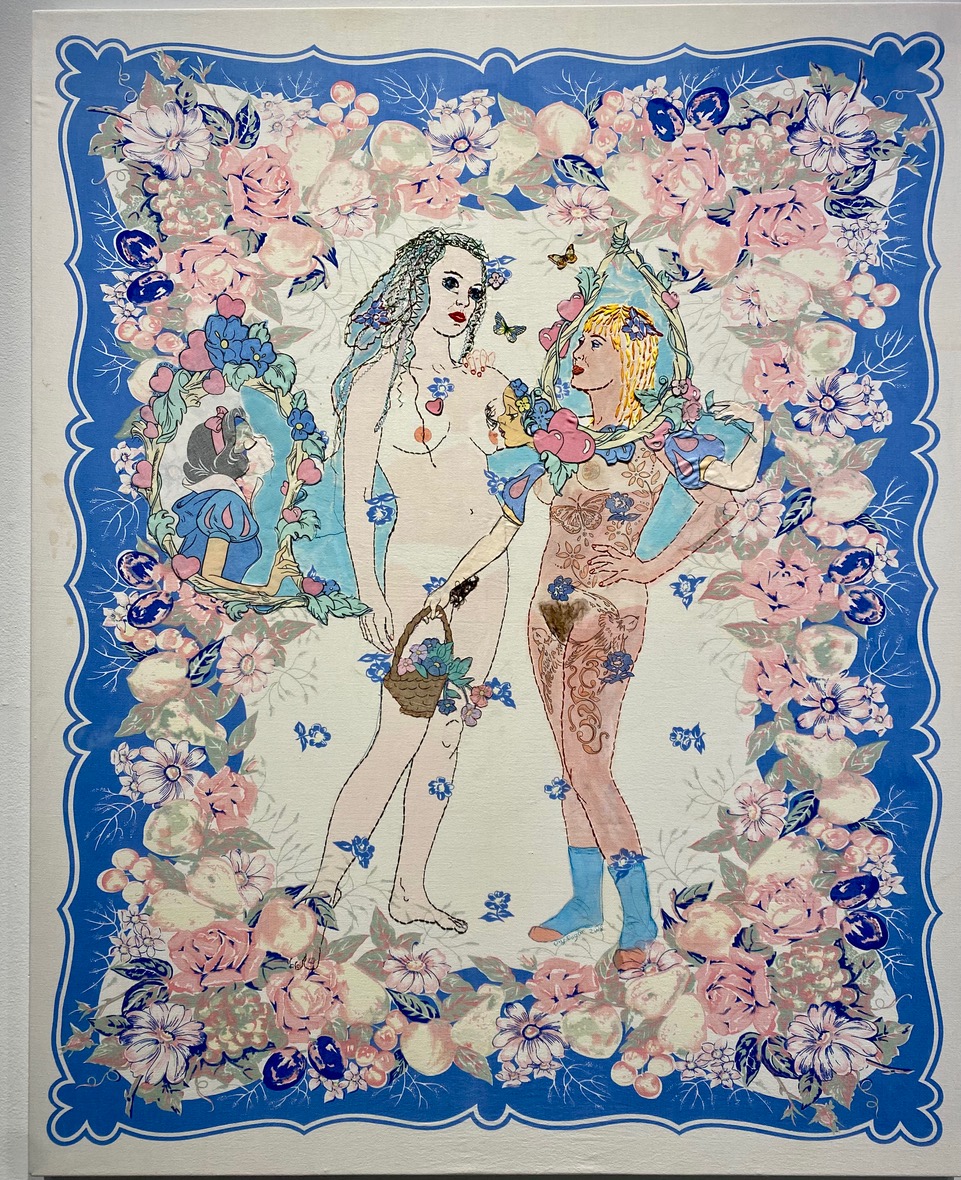
Bloom (2018)
63 x 50 inches
Hand stitched embroidery appliqué and paint on vintage print table linen
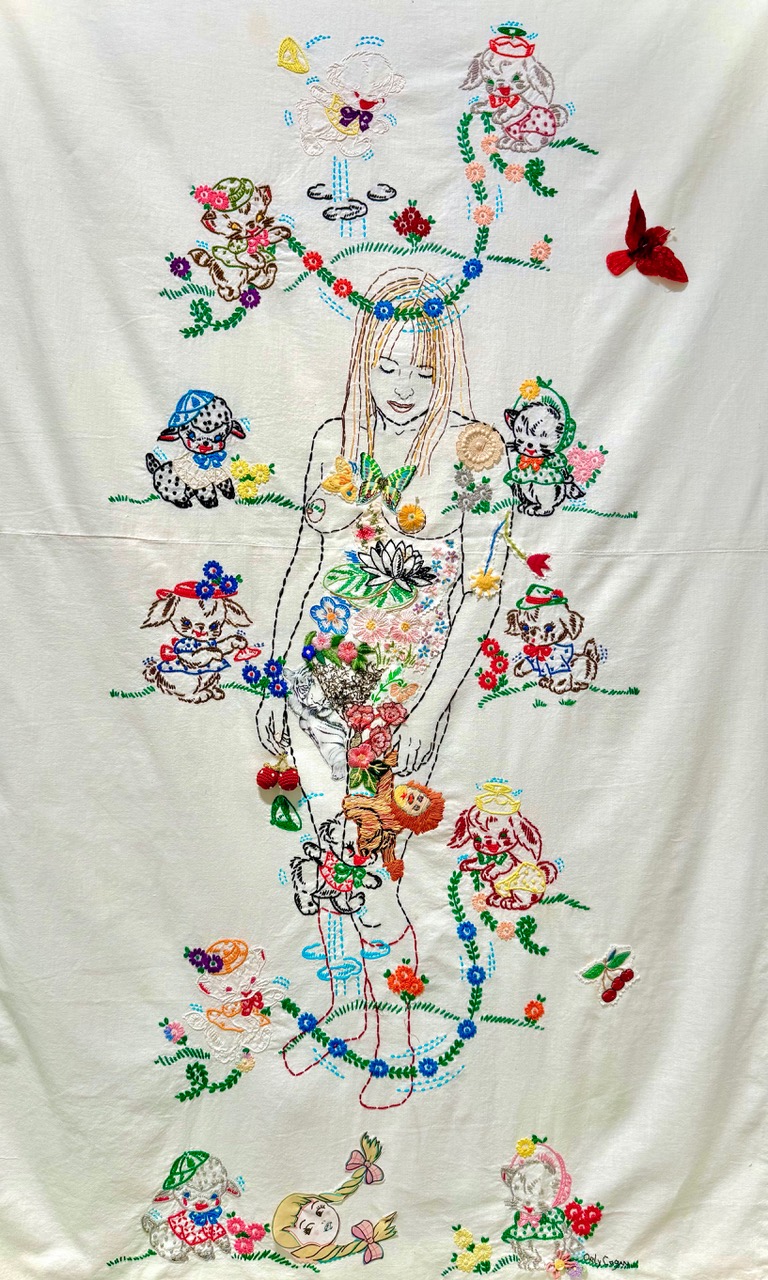
Woman Child (2026)
70 x 41 inches
Hand stitched embroidery and appliqué on bed vintage linen
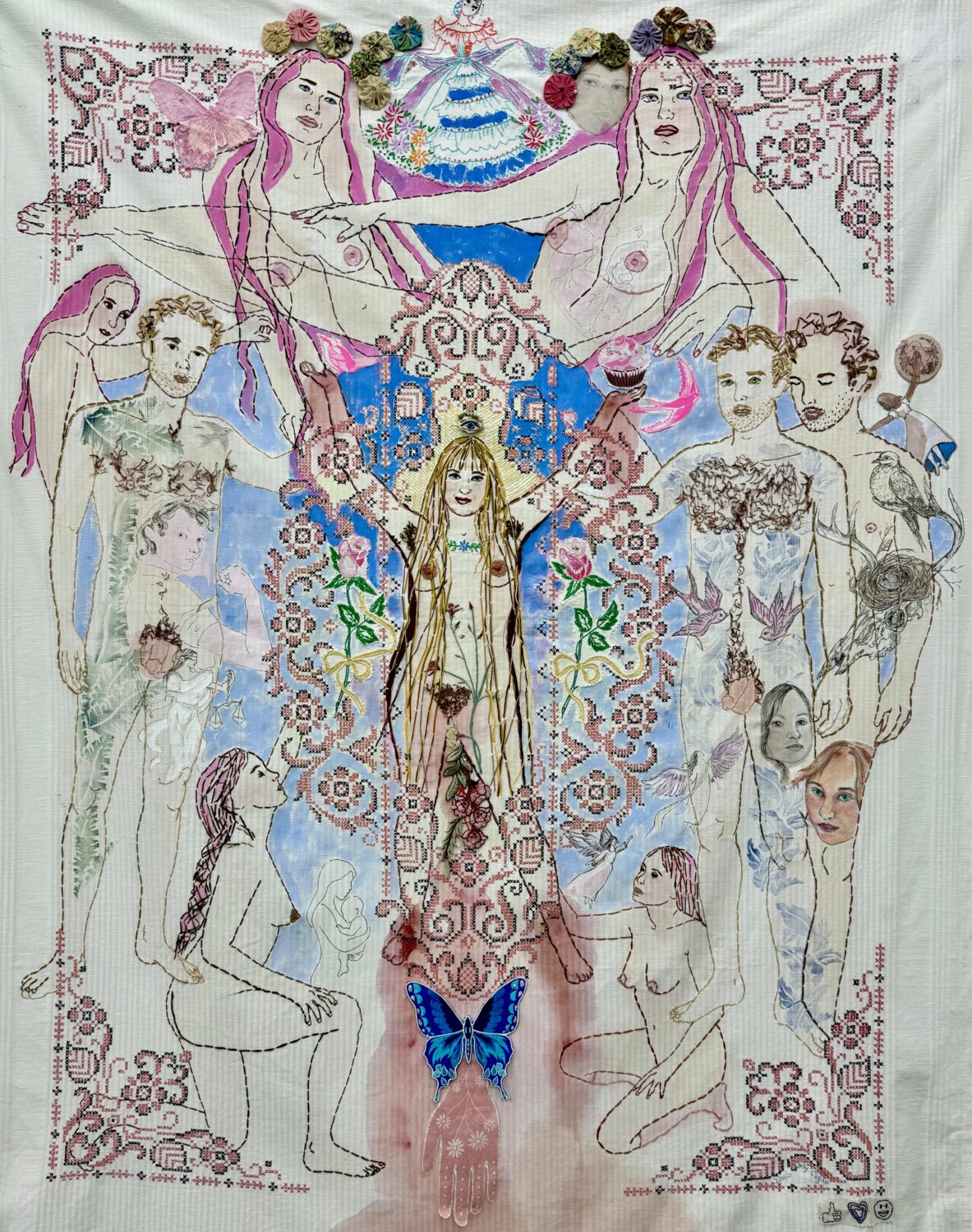
Painted Into Being (2026)
64 x 57 inches
Hand stitched embroidery and appliqué on bed vintage linen
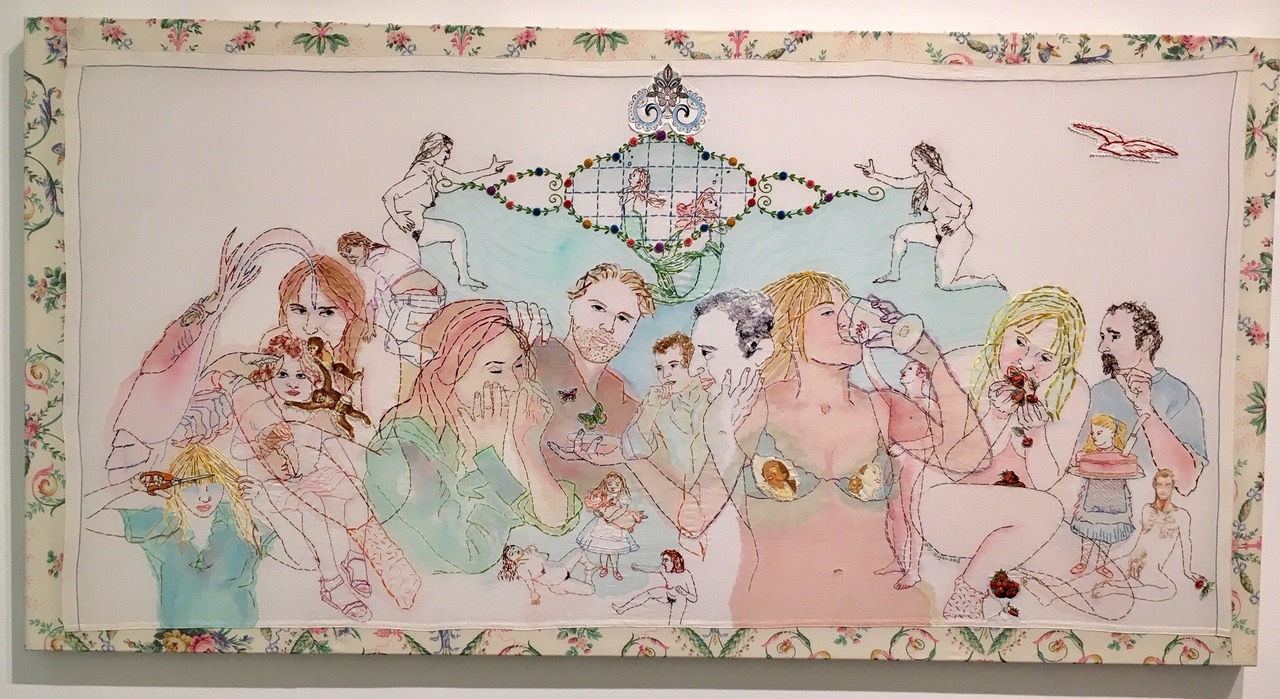
The Feast (2018)
68 x 32 inches
Hand stitched embroidery, appliqué and paint on vintage linen
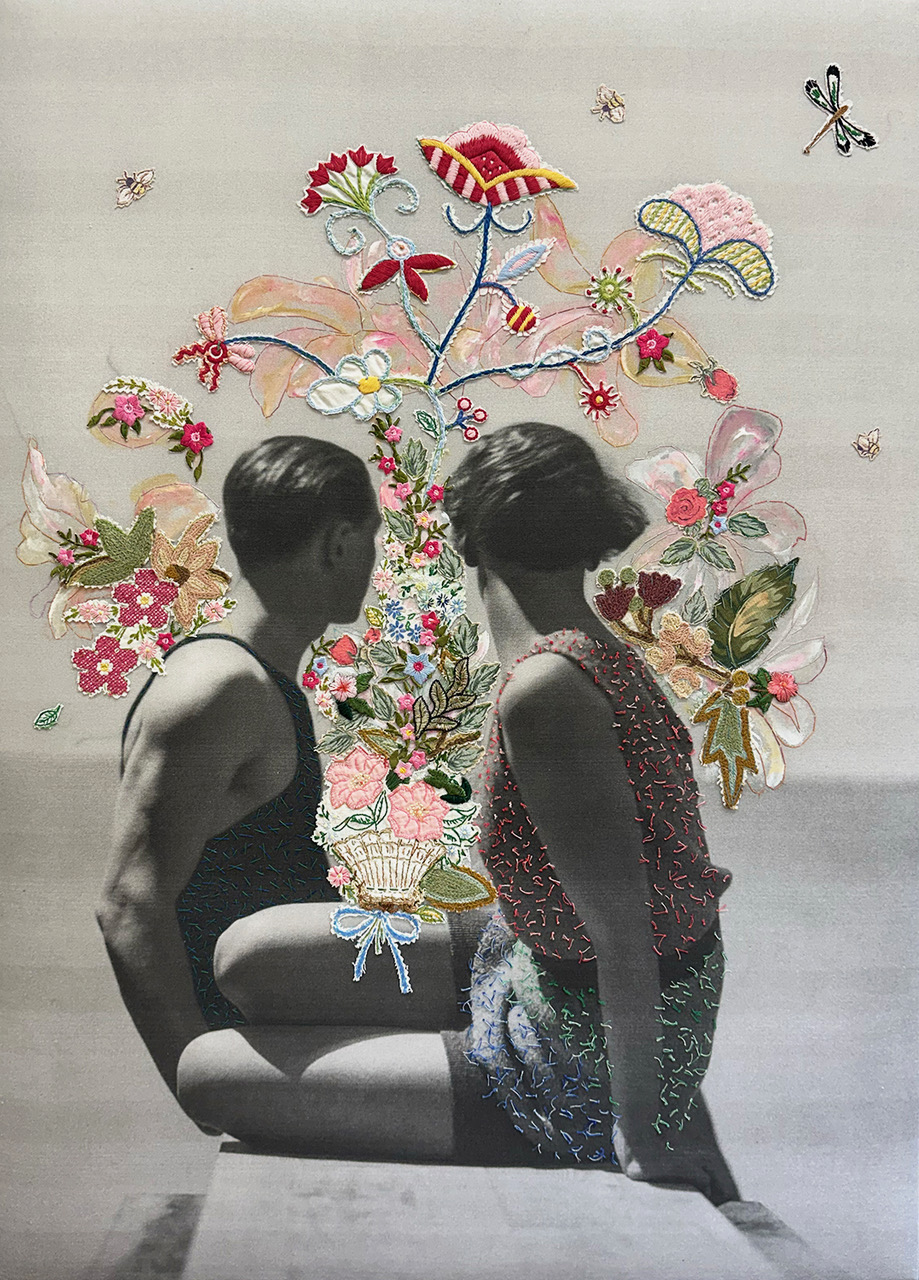
Full Bloom (2025)
37.25 x 27 inches
Hand stitched embroidery and paint on printed vintage table linen.
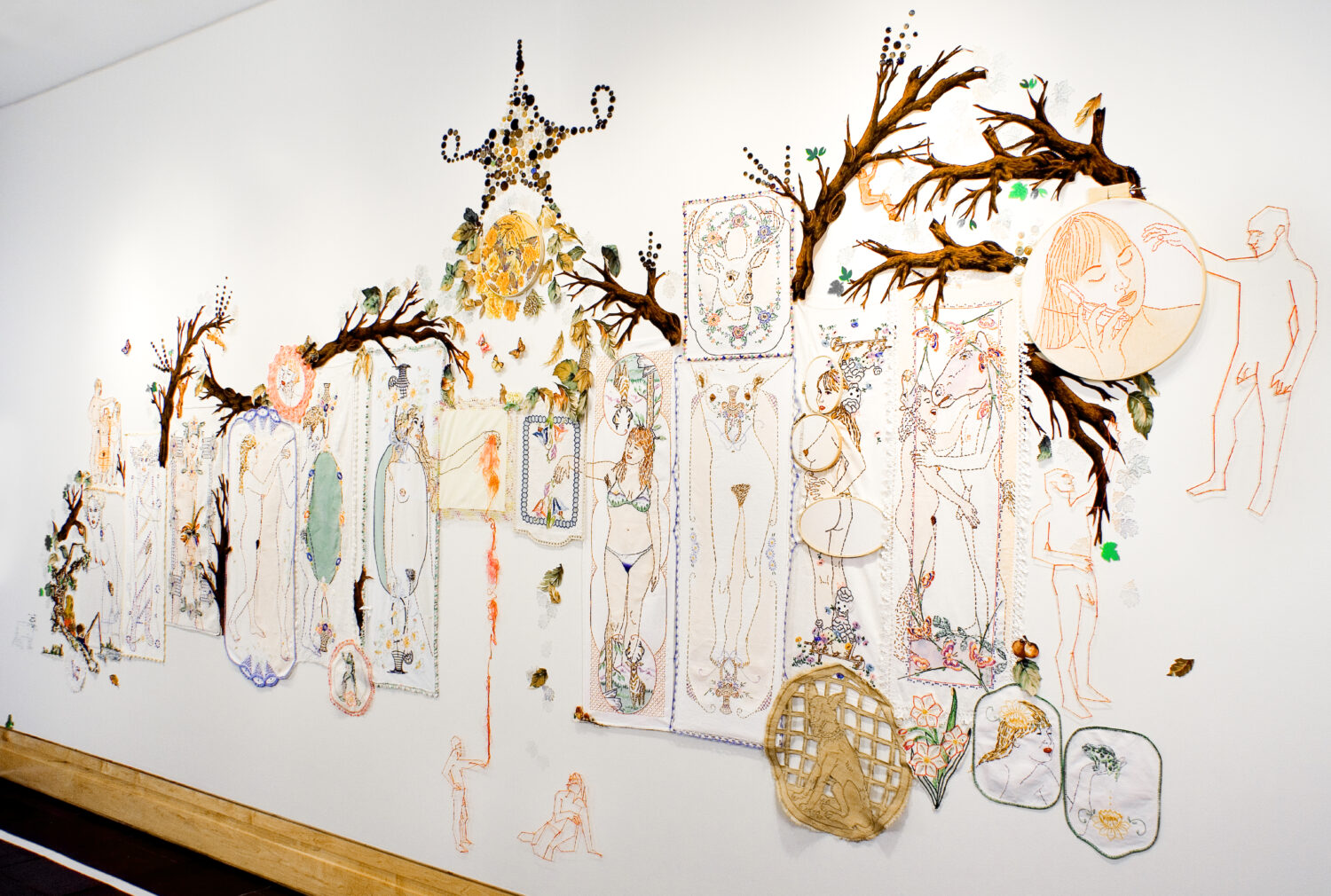
Quantum Entanglement (2006)
Installation – approx 12 x 20 feet
Vintage hand stitched embroideries and materials, thread, crochet, buttons ,embroidery hoops, various textile fragments
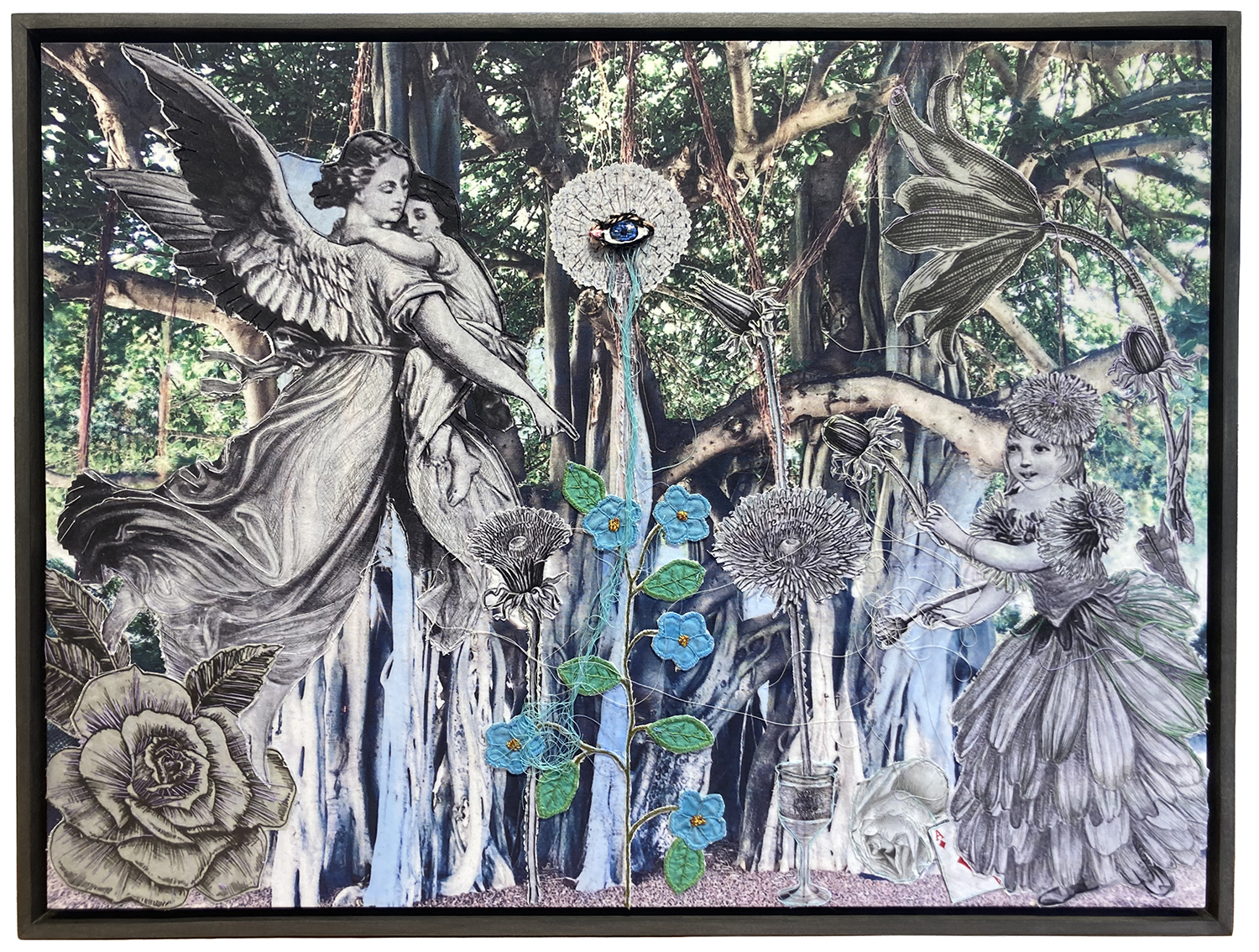
Rooted in Wonder (2026)
20 7/8 x 26 3/4 inches
Hand stitched embroidery, appliqué, and paint on printed photo textile
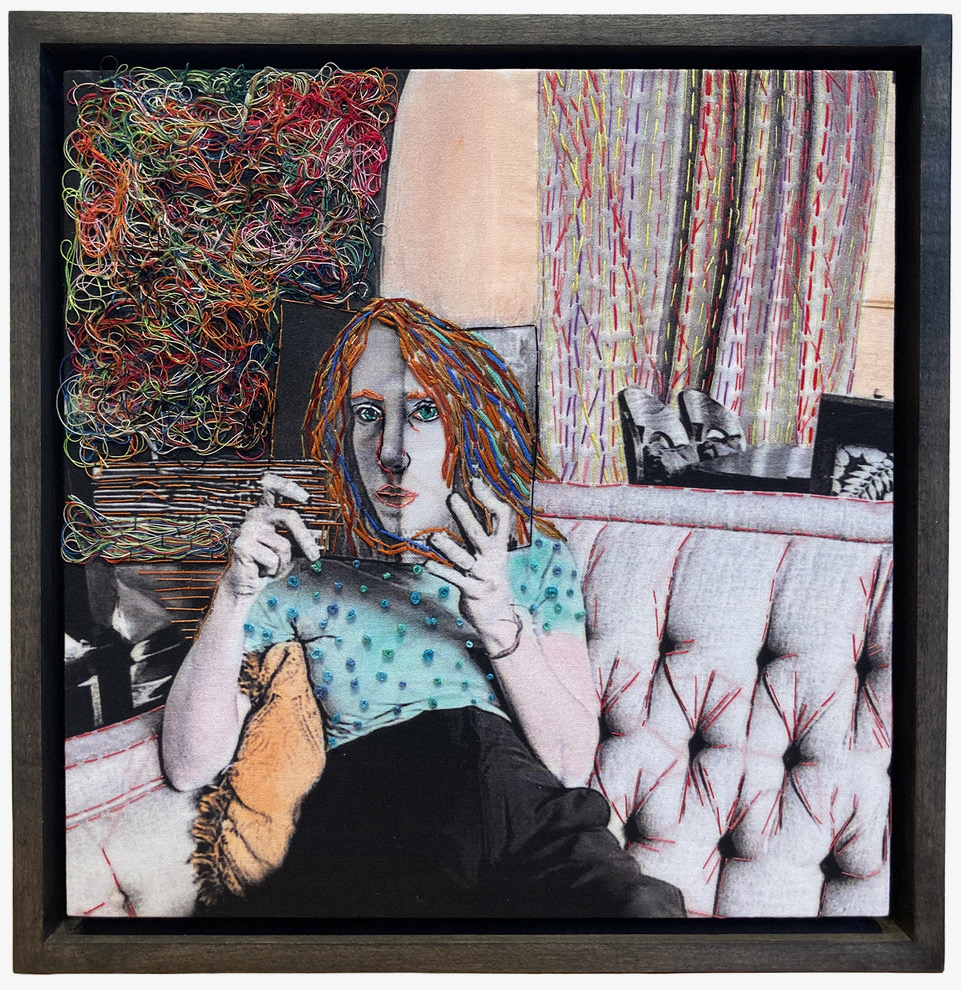
The Book Within (2026)
9.75 x 10 inches
Hand stitched embroidery and paint on printed textile
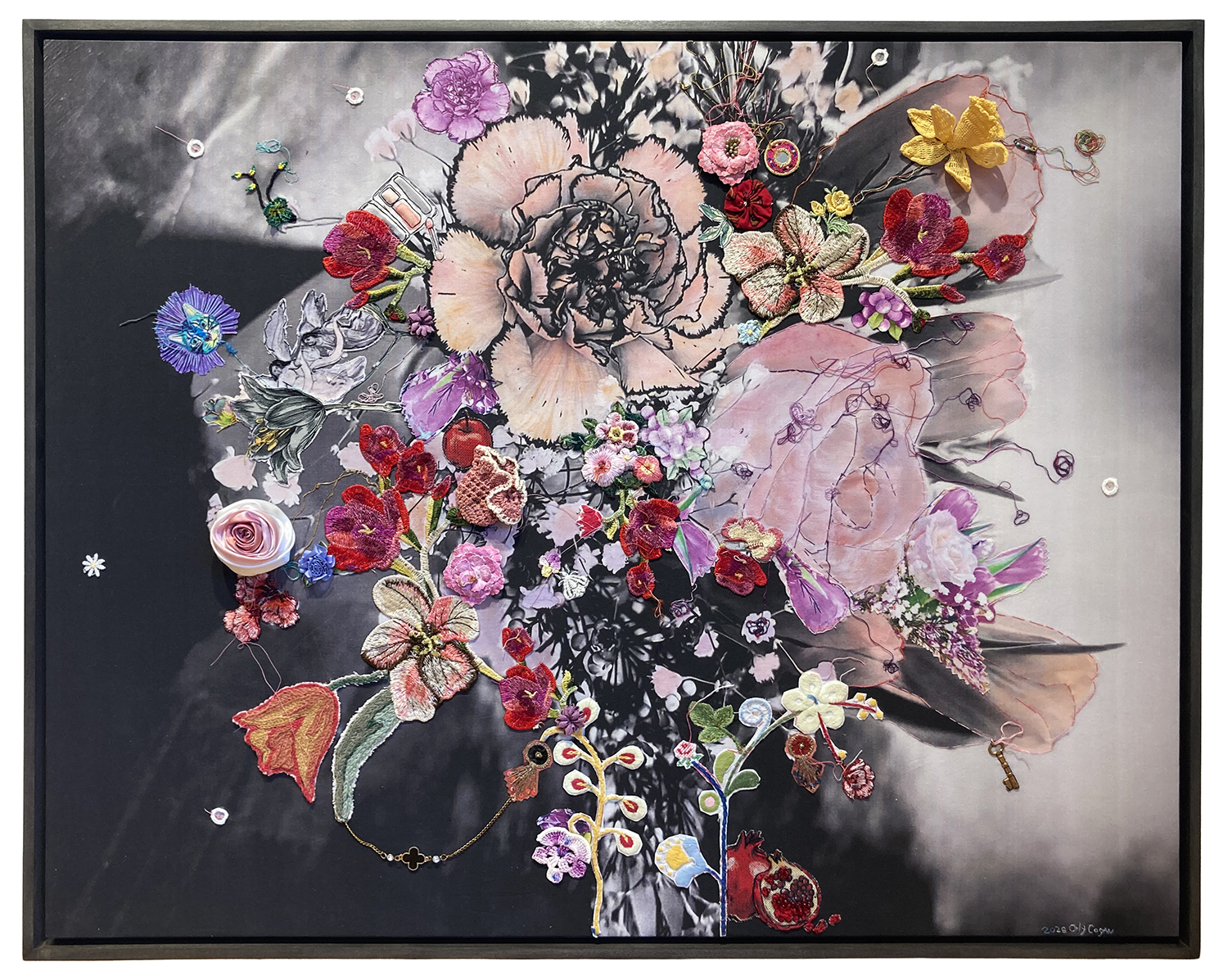
Held Abundance (2026)
28 x 35.5 inches
Hand stitched embroidery, crochet, silk thread, appliqué, beads,vintage metal work, paint and paper on printed photo textile
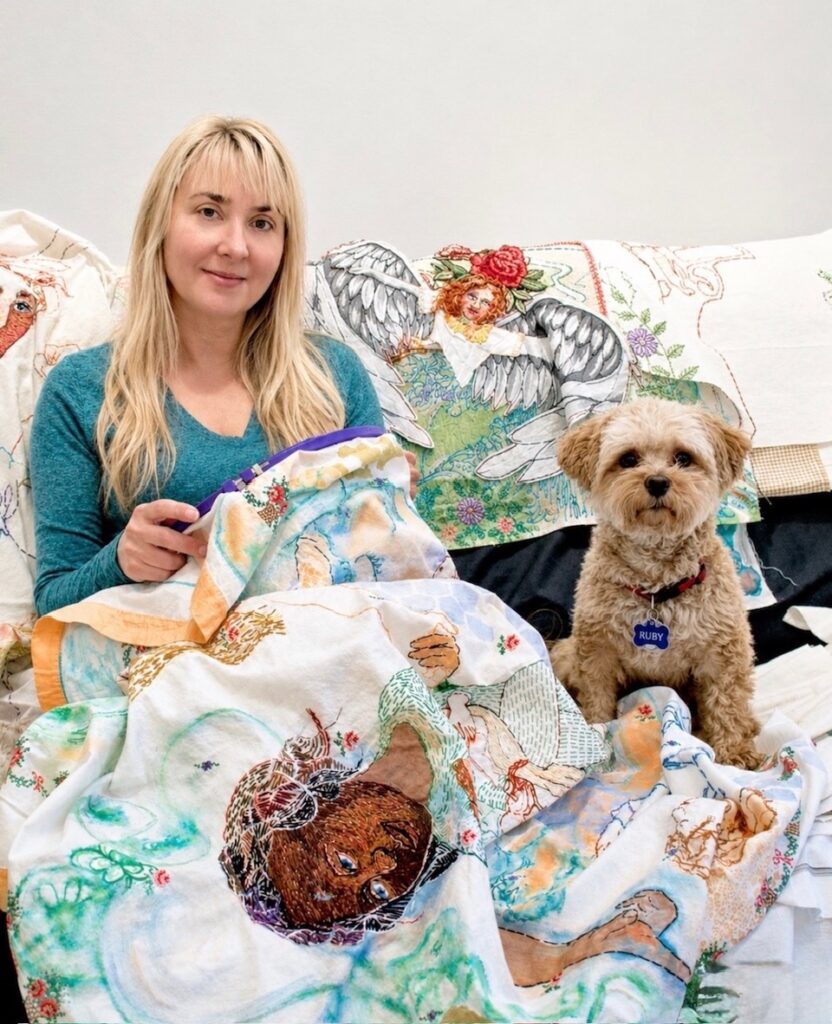
Orly Cogan’s hand‑embroidered art is rich with mythological references, recurring female figures, and themes of femininity and domesticity. Her practice has evolved over three decades into a uniquely playful, subversive, and continually expanding body of work. “I’m particularly drawn to the tension between the decorative and the subversive, when something that initially appears familiar or comforting begins to reveal a more complicated world beneath the surface.”
Tell us about your background.
I was born in Jaffa, Israel and grew up and live in New York. I went to art school at The Cooper Union For the Advancement of Science and Art , NYC and The Maryland Institute College of Art. I also spent a handful of summers as a teenager in Florence and Perugia, Italy taking painting and drawing classes in small independent studios. That’s where I fell in love with Renaissance paintings, particularly Botticelli’s scenes of Mythology with hidden symbols. These ideas I still carry with me in the work I make today. Most of my textile work skills I’ve made up and figured out on my own.
What are your early memories with making textiles?
My connection to textiles came quite naturally. I went to a Waldorf School where from an early age I learned how to knit, crochet and be comfortable using many natural materials. I grew up with lots of art in my home. From sculpture and paintings to antique Persian carpets and tapestries. My mother collected old embroidery and needlepoint samplers and had a deep appreciation for anything handmade. She made several stuffed animals and dresses for me. She has a Folk Art aesthetic and my grandmother collected quilts, so I grew up surrounded by these objects and the histories embedded in them. My father was drawn to Surrealist and figurative painting. Looking back, I see my work as a kind of meeting point between those two influences in a way: the handmade, domestic, and folkloric world I inherited from my mother, and the imaginative, surreal, and psychologically charged world that fascinated my father. I was fortunate to have parents that valued creativity and exposed me to museum exhibitions and travel.
What was your path to textile art ?
The actual beginning of my use of textile materials in my artwork happened almost by accident. My mother was supposed to attend a one-day quilting squares workshop at the Folk Art Museum in Manhattan, but she couldn’t go that day, so I took her place. I made a small embroidered nude figure on a patchwork square with a few beaded elements. That little piece received such an enthusiastic response from the small group in the class that I began to explore the possibilities of exploring that medium further.
Not too long after that, I was still primarily thinking and working as a painter when, in the mid-1990s, an independent curator and writer named Charlie Finch came for a studio visit to see my paintings. Instead, he became captivated by the hand stitched embroidered pieces I had tucked away in a corner. I hadn’t even put them out because I didn’t consider them gallery-worthy at the time. His enthusiasm was incredibly encouraging. He saw something playful, quirky, and distinctive in them, a bit perverse at the time and a voice that felt uniquely my own. That encouragement coming from someone who went to lots of shows in NYC and who was an incredibly outspoken character really gave me the confidence to keep following in that direction.
At the time, I don’t remember “fiber art” or “textile art” being terms that were widely used in contemporary art in the way they are today. I was somewhat aware of the Pattern and Decoration movement of the 1970s, which helped elevate craft, ornament, domestic materials, and feminist ideas within the art world, but I wasn’t seeing much new textile work in the galleries and museums I was looking at. Of course there were no cell phones or social media back then . In a way, that gave me a wonderful sense of freedom where I wasn’t consciously entering an established category; I was simply following what felt natural and exploratory to me. Gradually, thread became the medium through which all these different parts of my visual world ,painting, storytelling, history, irony, humour, and the handmade could come together.
What appeals to you about using textiles in your practice?
I was initially drawn to the inherent contradictions between the material and the subject matter I was interested in portraying. When I began working with textiles in the mid to late-1990s, I had not seen craft-based materials being used by contemporary artists in the way I was imagining. Vintage textiles often carried a sweet, nostalgic or conservative sensibility, while the figures I introduced could be awkward, mischievous, sensual and slightly transgressive. That collision immediately interested me, and the material became part of the meaning rather than simply a surface to work on.
Textiles carry a rich history of women’s work, labour, domesticity, memory, and storytelling. I’m drawn to the intimacy of constructing an image stitch by stitch and to the almost old-fashioned associations embroidery can conjure, a simple hoop, patience, and the quiet act of making something by hand. There is a sincerity to the process that I value, as well as the freedom to work on a piece gradually, wherever I travel.
Over time, I became increasingly interested in the dialogue between the textile and the image. The history and associations embedded in the material can add another layer to what is taking place within the work. I’m particularly drawn to the tension between the decorative and the subversive, when something that initially appears familiar or comforting begins to reveal a more complicated world beneath the surface.
How do you describe your work?
Honestly, I’ve never been entirely comfortable describing my work in words. I feel much more at home within a visual language, where ideas can remain open, layered, and sometimes unresolved. Of course, viewers can find context through my artist statement and writing about the work on my website but I also hope they bring their own experiences and interpretations to it.
In many ways, I’m more interested in hearing what others see. Once a work leaves the studio, it can take on meanings I may not have anticipated, and I enjoy that exchange. For me, the most interesting work leaves room for interpretation. My quick response when someone asks what my work is about, I say, I make hand stitched feminist contemporary fairytales.
Much of your work is instantly recognizable, how did your work develop over time?
The work has evolved organically over a long career, with each subtle shift growing out of the stage of life I was in, as well as the influences, experiences, and questions surrounding me at the time. Looking back, the changes feel less like deliberate departures and more like a continuous conversation between where I was personally.
I began with printed fabrics, adding small hand-stitched figures to the existing imagery. From the mid-1990s into the early 2000s, these figures multiplied into small, energetic, almost circus-like characters interacting with animals on printed and upholstery fabrics, Bacchanalian scenes, and nature motifs. The work was playful and irreverent, but also deliberately provocative, exploring sexuality, body image, female agency, and the complicated dynamics within intimate relationships. There was something mischievous about placing these subjects within materials traditionally associated with domesticity, femininity, and decorum.
Initially, the embroidery was dense, with thick thread building up the figures almost as I might have built them with paint. Gradually, I began to think of thread more as a drawing medium. The figures grew larger, the stitching became finer and more open, and I began using different weights of thread to suggest distance and perspective. Overlapping lines replaced much of the filled-in embroidery, allowing figures to intersect and inhabit the same space. As the technique became more fluid, the work also became more psychologically charged, with greater attention to gesture, vulnerability, desire, ambiguity, and interpersonal dynamics. The pieces also grew in scale and complexity.
My narratives then increasingly moved towards mythological and dreamlike worlds, populated by goddess-like figures and recurring characters. Popular culture and Art history references, biblical symbols, and fragments of my own life began to intermingle . These became a kind of personal mythology through which I could explore intimate dramas, love, attraction, power, jealousy, longing, fertility and the shifting nature of relationships. The work changed as I changed, and I think those different stages of my life remain embedded in it.
Photography grew naturally out of this process. I had always taken photographs as references for the gestures and poses of my figures, so photography was part of my visual vocabulary long before it entered the finished work. Eventually, it felt natural to bring the photographic image itself into conversation with thread. In that sense, photography was not a departure from the work, but another subtle development within the same ongoing language.
For me, the recognizable quality of the work comes not from keeping it fixed, but from allowing it to change while retaining certain underlying threads, literally and metaphorically. The materials, recurring characters, humor, and interest in human relationships have remained, while the way I see and interpret them has continued to evolve with me.
Is there anything else you’d like to add?
Over the years, I’ve built a recurring cast of female characters who appear across different works, almost like actors returning to tell new stories. I have admired how the Old Masters used the same figures to carry deeper meaning from one canvas to the next. For me, the female nude was born out of a deep love for those classical paintings and sculptures. I never thought of them as mere displays, but rather as expressions of strength and beauty. However, over the last couple years or so, as a mother to a teenage daughter, I’ve felt a shift. Our society has become oversaturated with media centered on the female form, which often creates insecurities or constant comparisons for young women.
It is a tricky balancing act to inhabit and convey these ideas as viewpoints shift, both culturally and personally. I am choosing to collaborate with my own artistic history by bringing a different kind of empowerment to some of my earlier pieces. I’ve gone back to some of those works and physically transformed them, layering the figures with intricate appliqué elements like blooming flowers, animals, and symbols of nature. I might veil a figure once to offer a quiet sense of privacy, but the real goal is to fill her with an other-worldly visual substance. They have always had the freedom to exist, but by grounding these women in nature and growth, they gain an even richer presence. It’s an evolution of their story that expands their world, giving them an entirely new layer of depth and autonomy.
What prompted using photos in your work ?
What prompted me to combine photography with textile was, in many ways, my own history with both mediums. I studied painting and drawing in art school and then thread, mixed media fiber based materials and textiles gradually became the primary language of my work over the past twenty-five years or so. Photography was always present in a quieter way, I have always taken photographs, and being married to someone who is deeply involved in the world of photography made me increasingly aware of how images shape the way we see and remember.
At a certain point, it felt natural to bring these two languages together. A photograph captures a particular moment, while stitching is slow, physical, and accumulative. By adding thread, felt, and other textile elements to a printed image, I can interrupt the photograph and move beyond what it initially records. The surface becomes both an image and an object, combining the immediacy of photography with the intimacy, touch, and labor of of my hand.
There is also an interesting history that the two mediums share. At different points, both photography and textile were considered by some circles in the art world to be somehow lesser than the traditional fine arts mediums. Textile because of its association with craft, domesticity, and women’s work, and photography because of its mechanical and reproducible nature. Today, of course, both are widely celebrated and have claimed an important place in contemporary art. I like that there is this crossover between them two former underdogs, in a sense, coming together.
Is this a new direction for you?
I’ve actually been developing this direction for more than a decade. I create theses pieces along side my other works as I don’t really differentiate as long as I’m making art . I’ve been making works on paper incorporating embroidery and appliqué, as well as photo-fiber pieces, and site specific installations on going. This exhibition, however, is the first time I’m bringing together more than twenty works from this ongoing series in a solo presentation, allowing the body of work to be seen as a sustained exploration rather than as individual pieces appearing intermittently over the years.
In these works, I layer photographs with hand-stitched line and texture, allowing thread to move across the image almost like a pencil or brush. The stitching creates another dimension, one that is tactile and dreamlike. The works move between observation and invention, reality and fantasy, and draw on my experiences of moving through the art world, along with ideas of fashion, performance, art history, looking, and being looked at.
While the imagery has shifted, that sense of playful innocence and imaginative freedom remains ever-present. The work is still rooted in storytelling, still interested in the space where the ordinary can become slightly esoteric, humorous, and magical. The spirit of curiosity, experimentation, and wonder continues to run through everything I make!
What was your proudest career moments so far?
That’s a difficult question, because there have been several moments throughout my career that have felt meaningful in very different ways. Three that immediately come to mind involve significant recognition and publication of my work, while another was an extraordinary opportunity to participate in a major exhibition in Hawaii.
In 2019, I was invited to take part in Art and Activism: An Exhibition About Change at the Maui Arts & Cultural Center, the show remained on view for three months. It was an ambitious undertaking and an experience I felt deeply honoured to be part of. There were six artists in the exhibition, and each of us was given a large individual gallery space within the enormous arts complex. My space was near the entrance, with soaring ceilings and an expansive areas in which to present several large-scale hand stitched embroidery works, as well as a new site-specific installation.
I had several large complex pieces hanging throughout the gallery, along with an exceptionally long wall that became the setting for the installation I created on site. In advance of my arrival, I shipped several boxes of materials to Hawaii and then spent more than a week building the work from the ground up on my own. I worked on ladders and from a cherry picker, often well into the night, as the installation gradually unfolded across the space.
The piece itself became a sprawling, meandering, somewhat magical and celestial environment composed of three-dimensional textile elements that moved across the vast walls. Using thread as a form of drawing, I connected lines between nails, allowing the work to project outward from the wall and play against the shadows it cast. These thread drawings intertwined with embroidered and beaded fragments, crocheted elements, buttons, and works held within embroidery hoops and flat pieces creating unexpected connections between the individual components and the larger composition.
Shelves held oversized spools of thread, from which strands extended outward to meet other figures and forms, creating an intricate web that continued across the installation. Elements seemed to grow, drift, moving between the flat surface of the wall and three-dimensional space. It became a lyrical, poetic environment, part drawing, part textile landscape, and part imagined mythological world where thread, shadow, and handcrafts created a sense of movement, mystery, and wonder.
It was physically demanding and complex to install, but also incredibly exciting to have the opportunity to create something so responsive to such an extraordinary setting. I loved the fact that the organizers trusted me to do “my thing” without first asking for sketches or an outline of specifics. I was given permission to work intuitively which is what comes most natural to me. The experience also included an artist talk and a video production, which made the entire project feel especially memorable and complete.
Another career highlight came in 2008, when Art Press magazine selected one of my works for the cover of Issue 351. The issue included a major feature examining the international rise of artists who were subverting and reimagining textile and fiber traditions. To have my work chosen for the cover, and placed within that larger conversation, was a tremendous honor.
Another particularly exciting moment came in 2020, when Jerry Saltz, art critic and writer for New York Magazine, selected my work for inclusion in New American Paintings, Northeast Edition, Issue 146, titled “Introducing 60 Exceptional Artists.” To have my work chosen by such an influential voice in the contemporary art world, and included among a group of artists he considered especially noteworthy, was an extraordinary recognition.
Each of these experiences was meaningful in its own way. The Maui exhibition allowed me to create something immersive and ambitious on a scale I had never experienced before, while the publications represented moments when my work entered into larger conversations about contemporary art. Looking back, they are all milestones that remind me of the unexpected places a long artistic journey can lead.
Do you have any advice for aspiring textile artists
My advice would be not to feel that you have to follow any particular definition of what textile art should be. I came to it quite naturally, and over time it became a language through which I could tell stories and explore ideas that interested me. I would encourage artists to experiment, to pay attention to their own relationship with materials, and not to be afraid of combining textile with other mediums. Sometimes the most interesting work happens when you stop worrying about whether something belongs to craft, fine art, or somewhere in between. That space in between can actually be a very exciting place to work.
Develop your own visual vocabulary. You don’t have to master every technique. Sometimes repeatedly returning to a few techniques or materials and pushing them in unexpected directions is what helps create a recognizable voice. And don’t be too focused on getting shown. It takes time to develop a personal style that is original and not a version of something that inspires you. Give yourself permission to play. Some of the most interesting discoveries happen through experimentation, mistakes, and combinations that initially don’t seem logical.
Behind the Lens & Through the Needle Orly Cogan’s solo exhibition is at Robert Mann Gallery in Chelsea, New York City.
September 10th from 6-8pm and will be on view through October 24. www.robertmanngallery.com