


A Shared Destiny (2013)
60 x 80 inches
Materials: Cotton fabric, procion dyes, textile inks, photo emulsion screen printing materials, fusible web, cotton batting, cotton and rayon threads.
Techniques: Hand screen printed images on hand dyed fabric, fused appliqué; machine pieced and quilted.
(Original images courtesy Library of Congress)
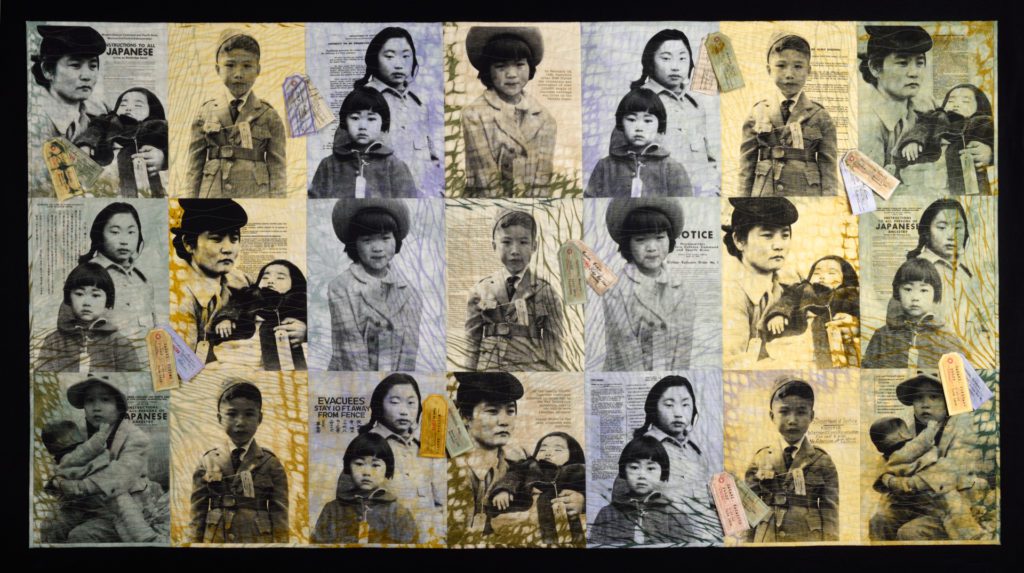
Tagged (2015)
45 x 84 inches
Materials: Cotton fabric, procion dyes, textile inks, image transfer materials, photo emulsion screen printing materials, fusible web, cotton batting, cotton and rayon threads.
Techniques: Hand screen printed images on hand dyed fabric, appliqué, fused, image transfer; machine pieced and quilted.
(Original images courtesy Library of Congress and Bancroft Library, University of California, Berkeley, with permission.)
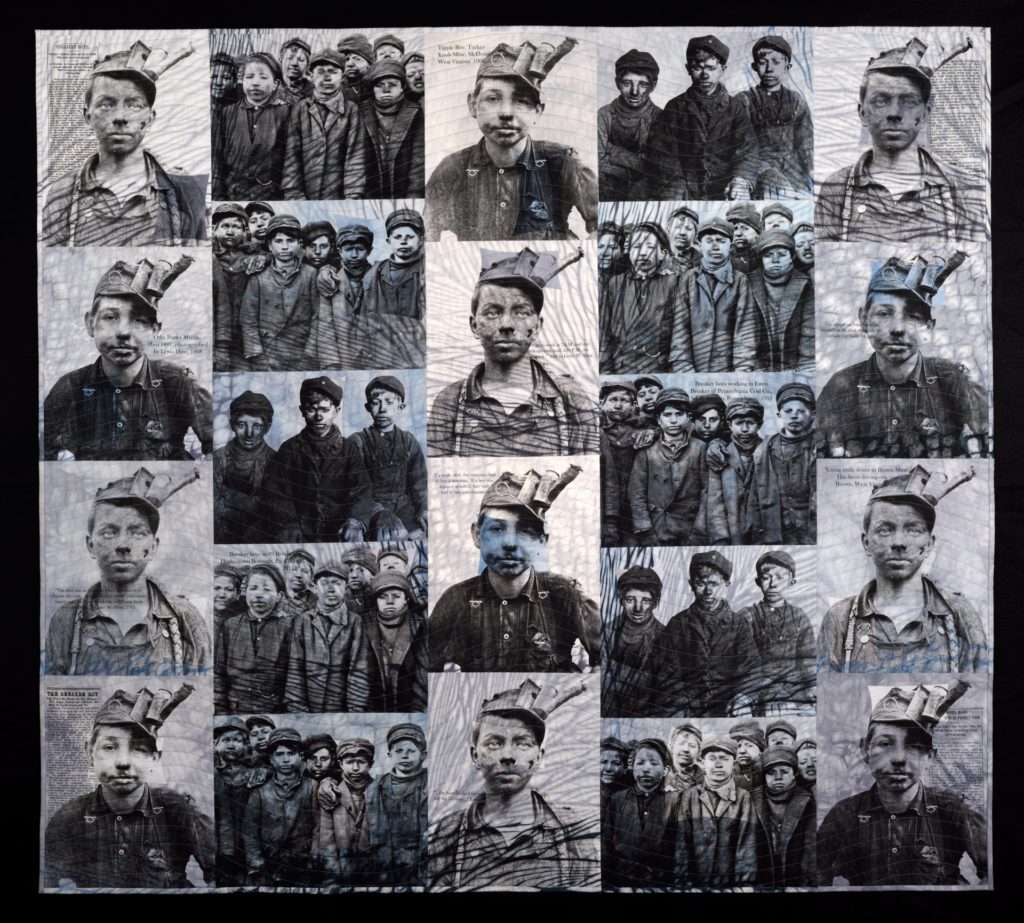
Grown Too Soon: The Boys of the Mines (2017)
60 x 66 inches
Materials: Cotton fabric, procion dyes, textile inks, photo emulsion screen printing materials, image transfer materials, fusible web, cotton batting, cotton and rayon threads.
Techniques: Hand screen printed images on hand dyed fabric; image transfer, fused applique; machine pieced and quilted.
(Original images courtesy Library of Congress)
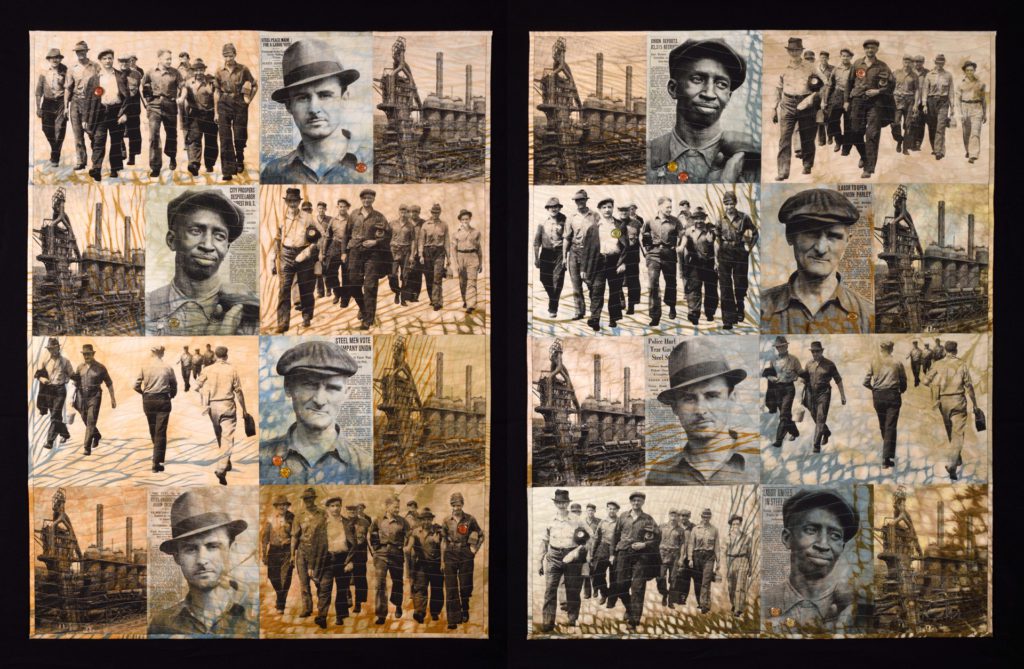
Steel Town: First Shift (2016)
48 x 77 inches
Materials: Cotton fabric, procion dyes, textile inks, screen printed, image transfer materials, cotton batting, cotton and rayon threads, vintage dues buttons.
Techniques: Hand screen printed images on hand dyed fabric; image transfer; machine pieced and quilted.
(Original images courtesy Library of Congress)
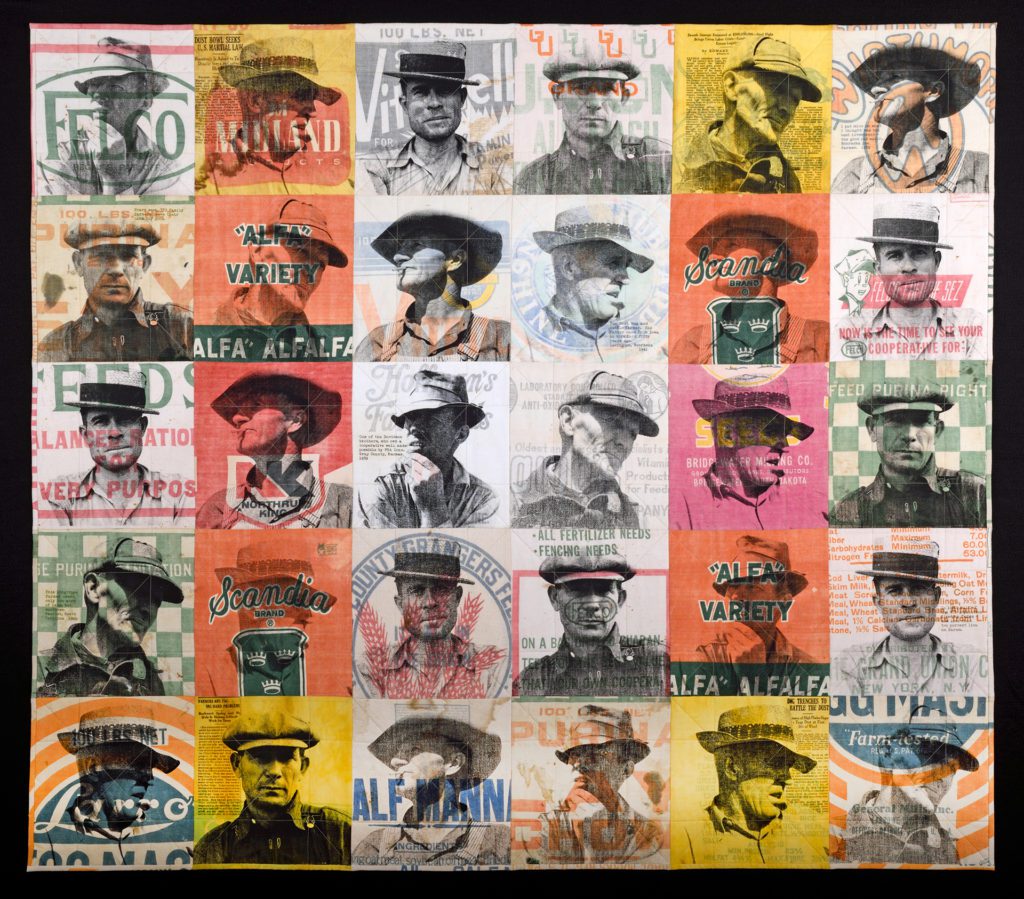
American Portraits: Loss in the Heartland (2015)
48 x 44 inches
Materials: Vintage feed sacks, textile inks, photo emulsion screen printing materials, image transfer materials, cotton backing, cotton batting.
Techniques: Hand silkscreened images on vintage feed sacks; image transfer; machine pieced and quilted.
(Original images courtesy Library of Congress)
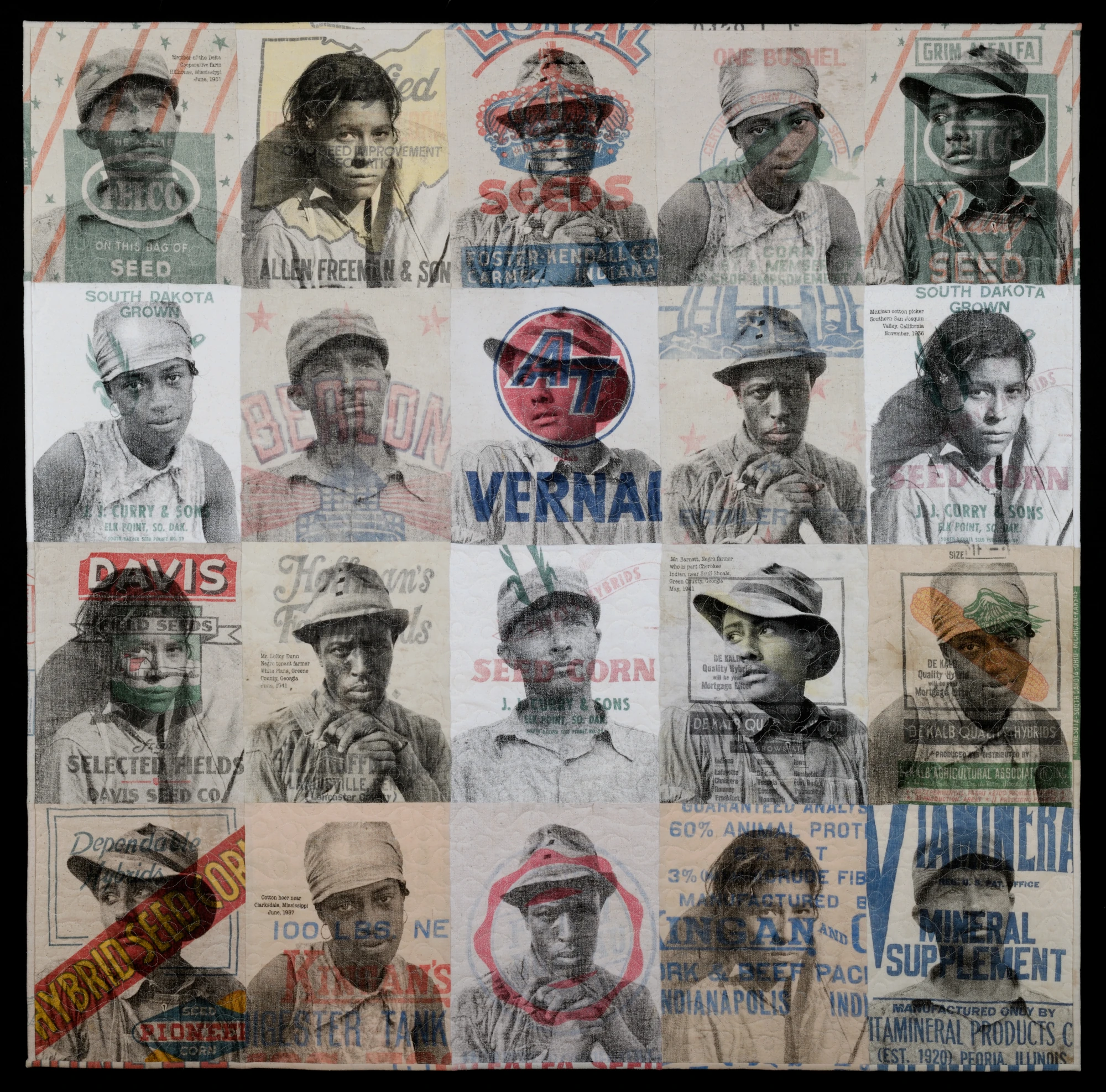
American Portraits: Deep Roots (2021)
56 x 56 inches
Materials: Vintage feed sacks, textile inks, photo emulsion screen printing materials, image transfer materials, cotton backing, cotton batting.
Techniques: Hand silkscreened images on vintage feed sacks; image transfer; machine pieced and quilted.
(Original images courtesy Library of Congress)
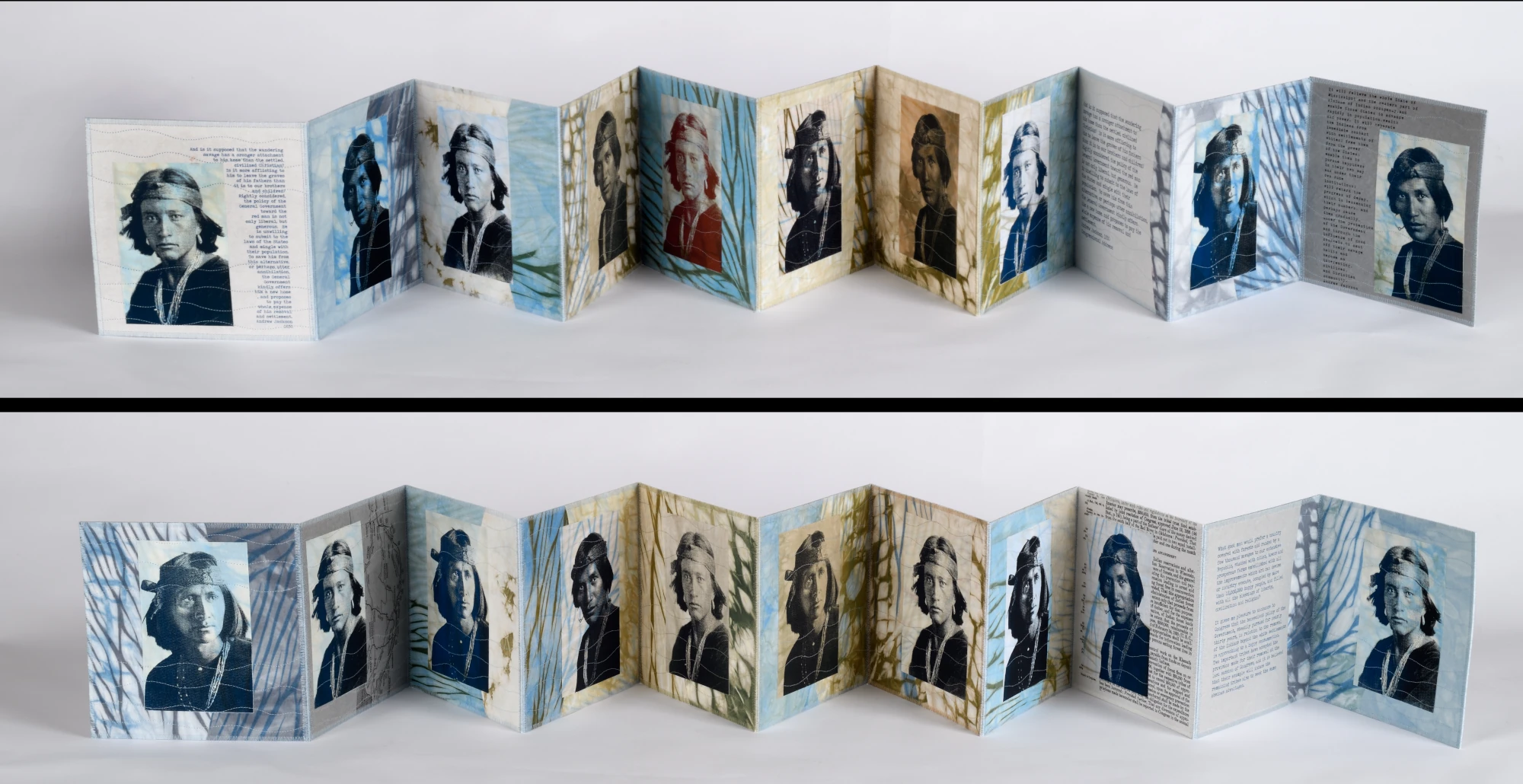
Shared Destiny (2022)
50 x 13 x 8 inches
Materials: Cotton fabric, procion dyes, textile inks, handmade paper, photo emulsion screen printing materials, peltex, fusible web, Peltex, cotton threads, vintage dues buttons.
Techniques: Hand screen printed images on hand dyed fabric, fused applique; machine quilted, machine stitched binding techniques, creating a two sided accordion book.
(Original images courtesy Library of Congress)
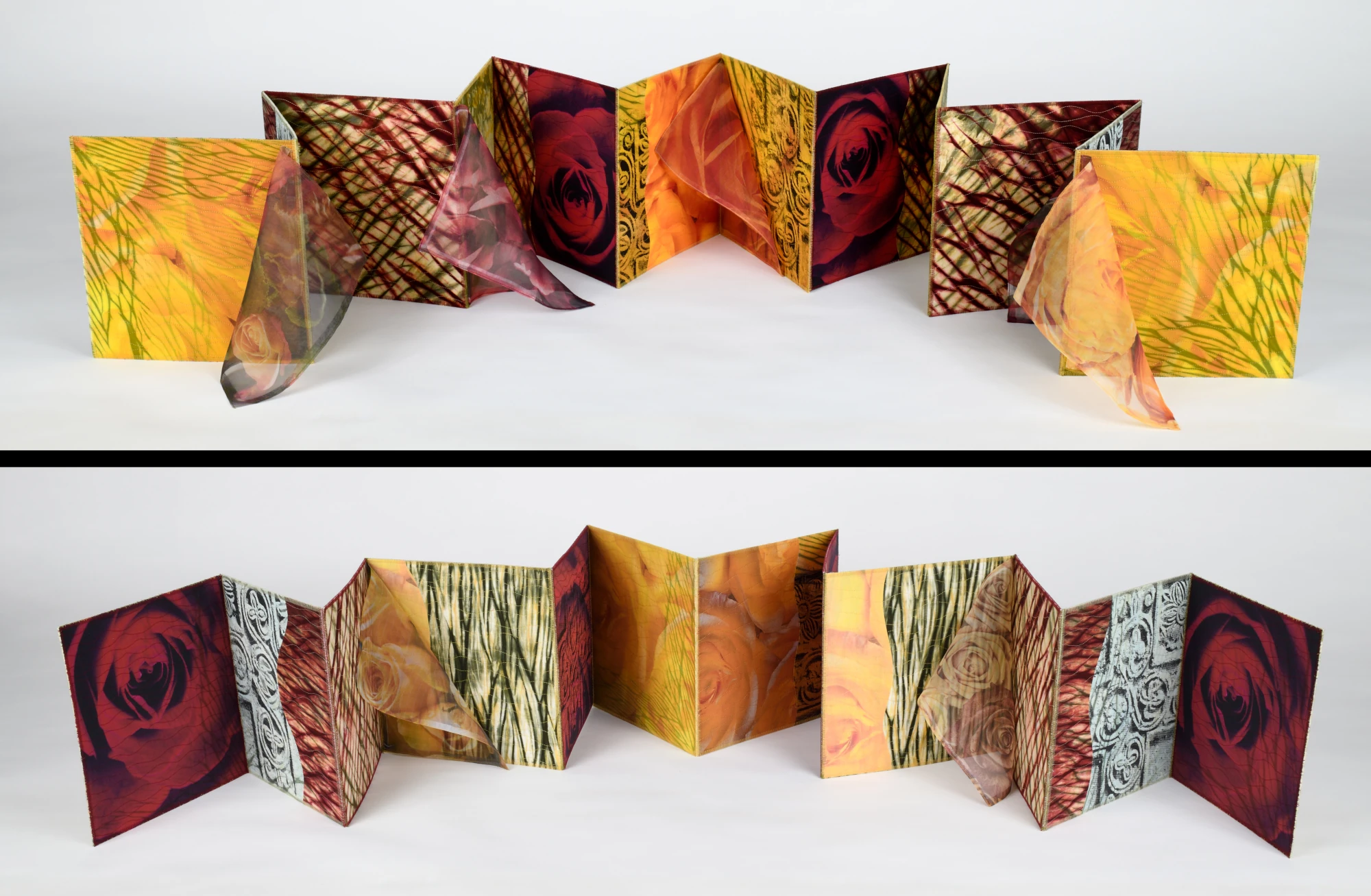
Rose Petals, Love Stories (2023)
47 x 26 x 10 inches
Materials: Hand dyed fabric, photo emulsion silk screen materials, digitally printed photos, organza, Peltex, fusing materials.
Techniques: Hand dyed fabrics and overdyed prints, screen printed patterning, fused applique, organza inserts; machine pieced and quilted, machine stitched binding techniques to create a two sided accordion book.
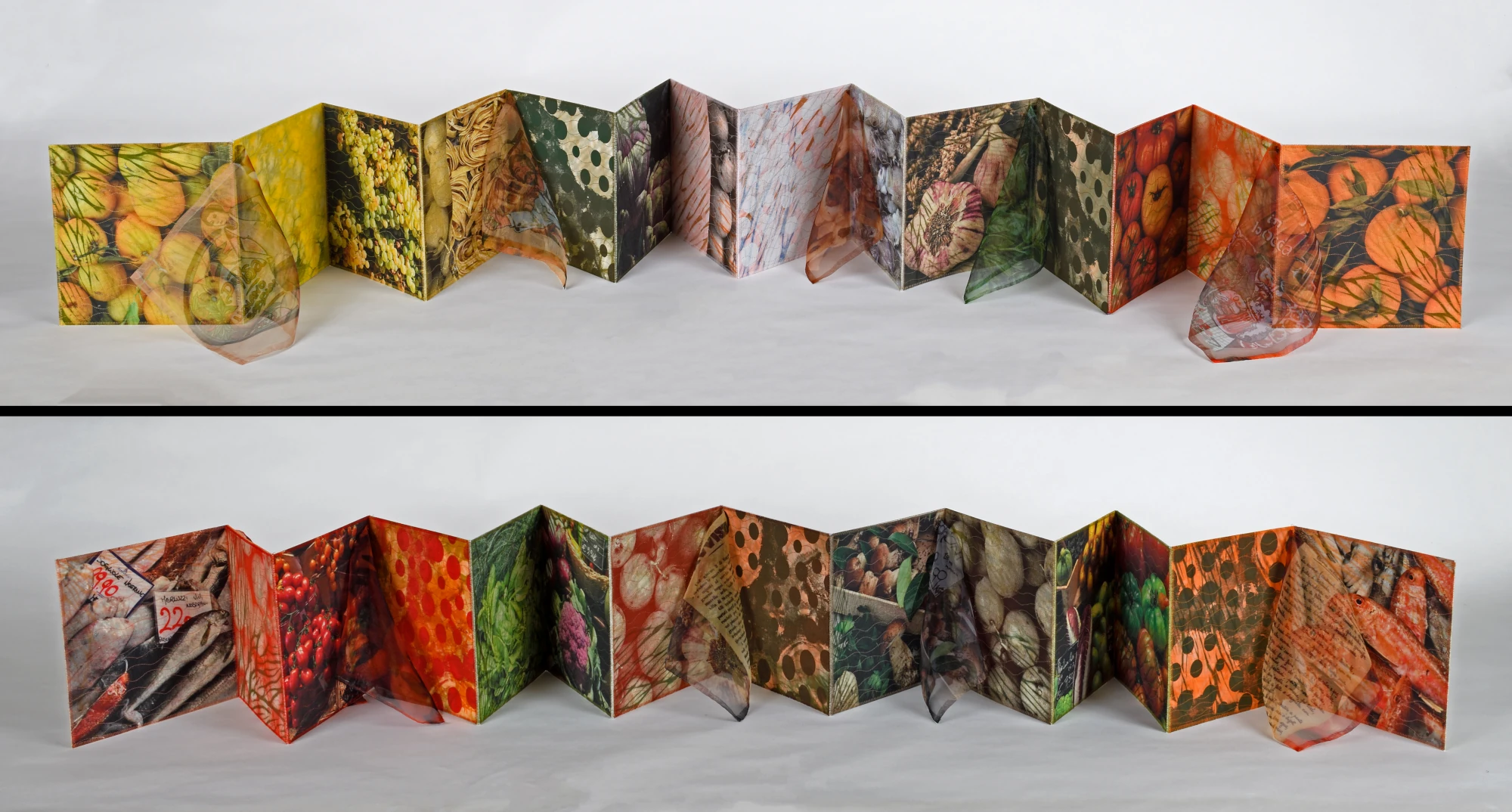
Mercati Del Friuli (2024)
71 x 10 x 15 inches
Materials: Hand dyed fabric, photo emulsion silk screen materials, digitally printed photos, organza, Peltex, fusing materials.
Techniques: Hand dyed fabrics and overdyed prints, screen printed patterning, fused applique, organza inserts; machine pieced and quilted, machine stitched binding techniques to create a two sided accordion book.
Firstly where are you based and where do you work? eg. in a home studio
I work from a studio space in my home, which is located in Murrysville, Pennsylvania, a suburb of Pittsburgh. My fabric is all dyed in the lower level of my home, and I do much of my printing at Artists Image Resource, a print facility in Pittsburgh. During the pandemic, I was able to set up a small print area in my basement, and will print small runs of images there. I am incredibly lucky to have access to AIR and their expert staff, for advice and instruction.
What is your background in textiles eg. are you self taught or did you study?
I have been sewing my entire life, but did not start making quilts until the mid-1980’s. Since I have no formal education in art or textiles, I would consider myself primarily self-taught. But I have been gifted by my membership in the Fiberarts Guild of Pittsburgh, which is the home Guild to some amazing textile artists. Through the Guild, I have been able to participate in workshops with some wonderful artists. Certainly my education in journalism, with a minor in photography, has had a tremendous influence on the style of work I create. But the real game changer for my current work, over the past decade, was learning to silkscreen, using photo emulsion screens, that can print an image life size, or even larger.
Can you briefly describe your textile career so far?
Initally, most of my work was traditional, but I began to venture into the art quilt movement in the 1990’s and started to exhibit my work – first in regional exhibitions, then national and international exhibitions. Working behind the scenes with regional exhibitions and organizations, including Fiberart International exhibitions had a large influence by exposing me to new possibilities and ideas of innovative work.
How do you describe your work?
Primarily my work is narrative, with an intent to create a personal dialog with the viewer, interpreted through their memories and experiences. People are reminded of a time, a person, even a family member, depending on their perception of the piece. Simply stated, my work is hand pulled silkscreen images on hand dyed fabric, or in the case of some of the pieces in the American Portrait series, on vintage feed sacks. The dyeing and printmaking are definitely my favorite aspects of the process.
Can you talk through the process of creating a piece, eg. do you work in sketch book, weave small samples?
My work usually begins with an image that appeals to me, or a group of images. Much of my work utilizes historical images, so there is considerable time spent, working on the images to prepare them for the screen printing process. Thereafter, I dye the fabric in colorways which reflect the subject matter in some way, and sets the mood. I arrange the dyed fabrics on my design wall to visualize the background prior to printing, perhaps dyeing more fabric or different colors. The dyed fabrics are printed, then the process of the actual making begins, which follows traditional concepts of piecing, quilting, etc. But after printing, often those initial concepts are drastically changed, as things can look quite different after the fabric is printed. Printed pieces get moved, rearranged, swapped, again and again, sometimes for days. This process holds true for my three dimensional, two sided accordion books; I arrange the front of the ‘pages’ and then the back, and sandwich them together when satisfied with the Peltex fusible.
I know its a hard question but roughly how long does one piece take?
The thought process and ideas can simmer in my mind for a long while, but once images are finally selected, I begin dyeing the fabric. Since most of the fabric is dyed more than once, preparing the fabric for printing can take several weeks of daily dye sessions. Printing is a relatively quick process in comparison. Then another several weeks of layout, piecing, and quilting. Making the books is very similar, as they are also quilted, then the edges are finished and they are stitched to each other. Since many of my quilts and books are very large, the entire time from start to finish can be months.
How has your work evolved over time?
Definitely my skills have improved over time, particularly in dyeing fabric. Recently, I have learned to screen print in multiple colors, rather than just one, which is complex, but exciting. Taking my work off of the wall, and presenting it in 3D books is a true shift in the past couple years.
Where do you find your inspiration?
It’s often just one image that often inspires me, and I begin to develop a story with additional images to build a narrative. Since I often work in series, that also is helpful; one story often leads to another. Since I have a journalism background, being able to tell stories through the medium of textiles is a perfect fit. The more recent books reflect on personal memories, utilizing photographs taken over the past 40 years.
Can you give any advice to aspiring textile artists.
My advice would be to create the work that makes your heart sing, rather than follow what may appear to be popular trends. Keep learning, try new techniques, and look at art created outside the textile medium. Let inspiration be your guide. And enter exhibitions; sharing your work is immensely satisfying.
What are you most proud of in your career so far?
Certainly, I am proud of my exhibition history, prizes and awards, but for me, the best measure of success is when my work touches someone in a personal way. Fortunately, I have not only been able to witness that occurrence at exhibition openings, but have received countless emails from exhibition visitors, relating how my work has touched them in an emotional way. To me, that connection is the true measure of success.